Meet Mojo! And my pick of the planty pods...
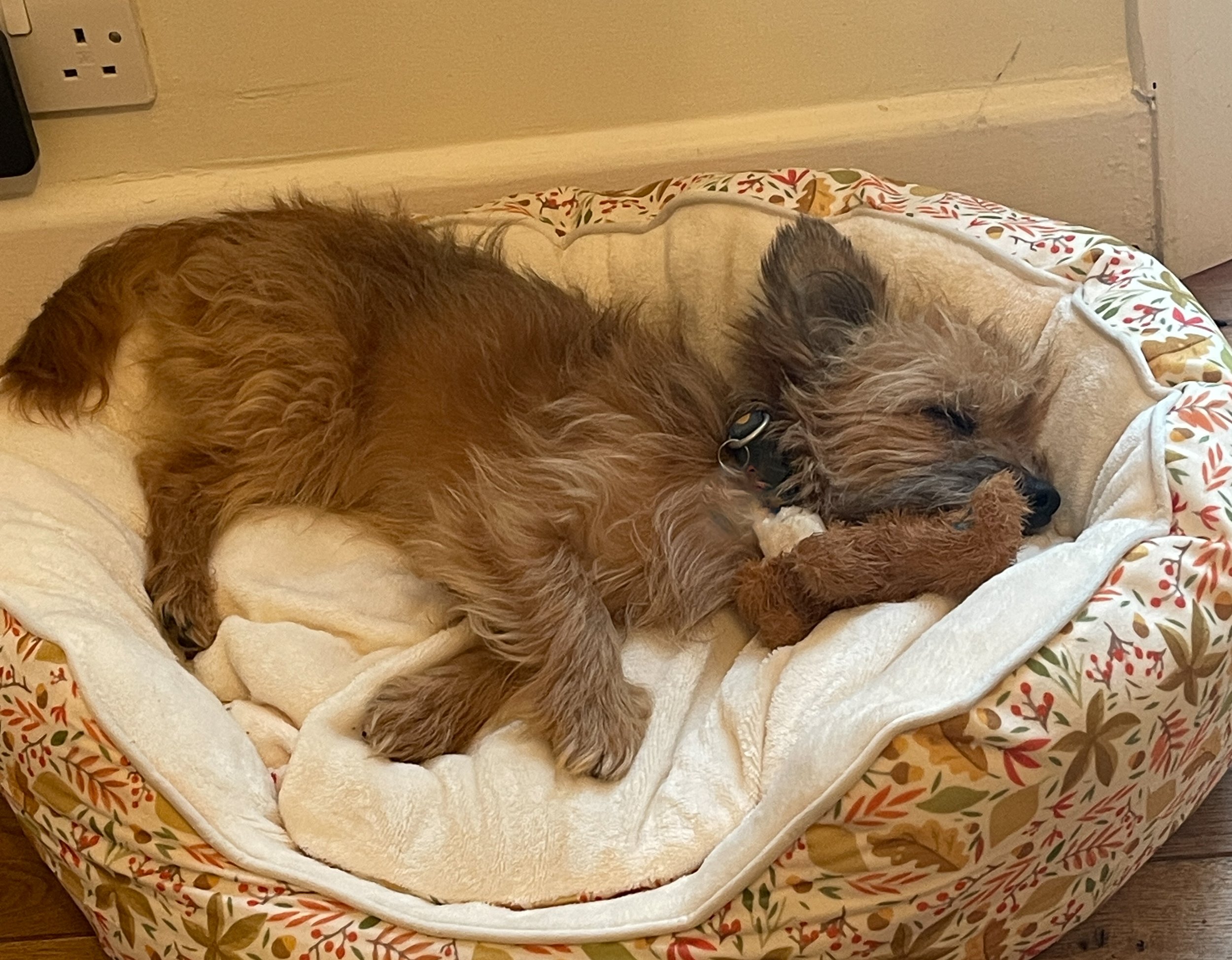
Mojo doing what he loves best. Photograph: Jane Perrone
Transcript
Transcript © Jane Perrone. Originally published at janeperrone.com. Please do not reproduce or republish without permission.
[0:36] But let's start with Mojo and what a great place to start.
[0:41] So those of you who've been listening to the show for a while will know that my dog Wolfie was the show mascot from the show's inception back in February 2017, right up till he passed away in November 2024. Oh, I didn't think I was going to get, I didn't think I was going to get emotional about that, but there we go.
[1:04] So Wolfie was a lurcher and, it was very tough when he went as it is for anybody who has a dog that they cherish when they go and it's taken me a while to, get be ready for another dog and then uh it took me a while to find a dog to have, not to replace Wolfie for sure but to have as my new dog and I've always tried to support rescues so Mojo my new dog is a rescue, shall I tell you a little bit about him uh he is totally different from Wolfie so Wolfie was about 16 and a half kilos, Mojo is just over four kilos so he is a little dog he is some kind of terrier mix, unfortunately a lot of Mojo's history is a blank slate because he came in as a stray to rescue into the pound, and therefore we don't really know anything about his life his age has been estimated by the vet as being around eight, he had to have some dental work done when he came in because he had a lot of rotting teeth so he's only got about half his teeth now and he was neutered at the same time.
[2:30] But safe to say that he is a little bit shell-shocked. He's had a rough few months. But his character, having had him now for about five days, his character is starting to come out. And he's a delightful little fellow. Now, I wanted a lapdog, and I've certainly got one. He loves to cuddle up on my chest of an evening and just enjoy the warmth of human company. And he's in my office right now sitting on the chair. I'll try to put a picture in the show notes of him on the chair, the armchair that is in the corner of the office and he gets to look out the window and he just loves to sit there while I'm working. And he is, as I say, a very much a blank slate. We don't know much about his history. What I can tell you, having had him for five days or so now is that he really hasn't had any of the doggy training or, life skills put in place in the course of however many years he's been on this planet he doesn't know how to sit he doesn't know, any commands he doesn't know, he walks quite nicely on the lead but he we are starting from.
[3:49] Absolute zero when it comes to training so today I've had my friend and dog trainer Valentina Montoya of Val's Canine, to come in and begin helping me with that because, I don't know about you but it's such a long time since I've had a dog that didn't know how to sit in the form of a puppy that I wasn't sure where to start with this but Valentina is a brilliant dog trainer she's very experienced with rescue breeds of all kinds so she was pretty quick to figure out.
[4:20] Mojo's strange ways and we have begun his training regime so he's going to be, getting lots of enrichment and work on life skills that will help him stay safe and help us to keep him safe so we're not just doing stuff just for the sake of oh look at the skills my dog has look how clever my dog is it's all about actually making sure that he can live in the world and exist around other people safely, but it's really early days if you've ever had a rescued dog before you'll probably know the rescue dog rules which are basically three days three weeks three months and probably three years to be honest so you know the first three days they're going to behave in one way, in three weeks time their behavior is going to start to develop a little bit more and their true personality is going to start coming out and really only after three months will you truly know that dog and that was certainly the case with my previous rescue wolfie, so it's a journey um there's lots to learn we've got to figure out how to keep his coat in good condition because he has a coat that I would say.
[5:38] Would as I say we're not sure on the mix but I would say Yorkshire Terrier in there he's not a big shedder so I'm going to be speaking to a dog groomer to you get advice on getting him used to being groomed and brushed, and get him tidied up at some point so there's lots and lots of things going on for Mojo right now but for the minute the main thing is he's just able to decompress and get used to being in our house, but I hope that I can do right by Mojo however long he's with us hopefully as a small dog he will live quite a few more years but it's going to be an interesting journey so I'm sure you want to say hello to Mojo, and I'll keep you posted along the way about his progress. I know this isn't a dog podcast, but I know a lot of you love dogs and love hearing about them. So there will be the odd mojo mention here on the podcast and over on my Instagram, where I'm at j.l.perone, I have been spamming with.
[6:50] Now it's time for some housekeeping and I wanted to talk a little bit about Patreon. I know this is something that not everyone who listens is interested in, but this is how the show actually stays on the air. So it's important to me. And I'd like to say a thank you to my new supporters, Christine, who became a legend and Chrissy, who became a super fan. And Jeremy, Claudio and Alkaev, who all took out seven day free trials of the legend tier. So they get loads of extra benefits. They unlock bonus episodes, ad free episodes of the main podcast, my planty posts and the Christmas mail out. And if you are a subscriber of mine on Patreon and you're a legend or a super fan, do go and check your address on Patreon. I've sent you a message about this on Patreon explaining how you need to check your details so that you can make sure that you get your card through the mail. I can only do that if you give me the address and indeed the correct address. So I will send out another reminder before the deadline.
[8:03] Which is November the 10th. So time is running out to check that you have the right address for the mail out. There are instructions on how to do it. I'll put them in the show notes as well. And you can make sure that you get your Christmas mail out because it's going to be cool this year. As always, it's got a nice card done by me with a handwritten note and the super fans get a little bit extra too. So if you want to sign up for the mail out, you need to do that before or on November the 10th, because I can't guarantee that I'll be able to get a card out to you after that, because it does take some time to get everyone's, address labels printed, handwritten notes done, etc, etc.
[8:50] And if you're not in a position to provide anything in the way of a donation, then that's cool. You can join as a free member too, and you get access to my planty posts. And I've just written a free post which covers book choices, planty book choices coming up to Christmas to add to your festive or autumn reading list. And I'm just about to put a post up about a viral internet meme surrounding a tree that I'm going to debunk. It's kind of a fun one. So that'll be going up either today, if I get the chance, or very soon. So the other nice thing about becoming a free member or a paid member is you get access to my lounges where you can go to the plant clinic and you can ask questions about your plant and talk to other planty people and me about planty things. So it's a lovely community and I'd love you to be a part of it.
[9:50] Now it's time for question of the week and this one is about wick watering. I've covered wick watering a few times in the past in On the Ledge but let me give you a refresher. This is where you take a wick, a piece of string effectively, usually quite a chunky piece of string. I like to go for something about half a centimeter across and usually a nylon piece of, cord rather than cotton the reason being that nylon lasts forever and doesn't rot in the water what I tend to use is the handles of old gift bags that have gone south you can go into a habdashery shop and buy a cord in there or if you're in the scouting slash guiding movement I think it's known as paracord, so you get a length of this stuff and, you have to maneuver it up through the drainage holes of the pot, and make sure it's in contact with the substrate then the other end of the string the cord, dangles like a tail out the bottom of the pot and goes into a substrate such as expanded clay pebbles or gravel, which is covered with water.
[11:08] So that the plant can pull up by osmosis the water that it needs but the question from Rebecca is this and Rebecca notes this seems like a dumb question now Rebecca let me say there's no dumb questions there really aren't I mean any question that is worth asking is not a dumb question and this is definitely worth asking, how the heck do you get the wick both up in the substrate and down in the laker in the lower pot i feel like i need x-ray vision and four hands yes rebecca yes you do.
[11:44] I would say that you really do need forehands and x-ray vision to get this right. It's not the easiest of things to manoeuvre the wick into place, particularly if you're retrofitting a wick into an existing pot. The dream scenario is that you put the wick or wicks, if you have a large pot, in position when you're repotting because then it's slightly easier because you can actually have the wicks in position, already located up through the drainage holes and then you can pour the substrate on the top and they're already in contact with the substrate and kind of get nestled in quite nicely. The problem comes when you're trying to do it after the fact. And as you say, you've not only got to get the top half of the wick up through the drainage holes and in contact with the substrate, but you've also got to get it down into the lake below. And there's no there's no easy answers this is the kind of task where I will be as we say here in the UK effing and jeffing while I'm doing it which basically means I'm going to get a little bit annoyed, what I would do is this I would use my old friend the chopstick and I tend to get the wick kind of wrapped around the chopstick and then I aggressively.
[13:05] Push it through the holes and up into the substrate so it's getting some purchase, because you don't want it to just be sitting loose at the bottom of the pot, and especially if your mixture is quite free draining you might find you do need to use a little bit of encouragement to get it right so yeah chopstick through the bottom keep poking until, a decent amount of the wick disappears you want the top third of the wick to be, inside the pot at least.
[13:35] So then you're left with the danglers, the tails, and now you've got to get them into the bottom layer. Now, what I tend to do here, again, you do need lots of pairs of hands for this, but you can kind of do it on your own. If you've got an inner pot and an outer pot situation, so your plant is in a plastic nursery pot with the wicks coming out and you're going to put it into a larger cash poo or, outer pot or whatever you like to call it, then I tend to make sure that the cash pot is, quite a reasonably bit bigger wider than the inner pot because then you can kind of, clamp the nursery pot to the side of the cash pot, above so it's lifted up so it's not actually touching the bottom allowing the wicks to dangle and then I carefully manoeuvre the laker or gravel, maybe using a funnel actually is often works really well, down to the bottom so that the wick gets filled in around by that sort of substrate, that drainage, whatever you choose to use. It's easier with smaller drainage substrates like pawn or gravel than it is with large balls of expanded clay pebbles aka laker and then I just generally give it a bit of a shaky shaky maneuver to get the wick.
[15:05] Sort of situated.
[15:08] It's not an exact art I have to say you do want the wick bottoms to be in contact with the gravel or laker because you want them to be able to touch the water and absorb it. So there's a bit of judgment here, but most of the time, you'll get there and you might have to do it once or twice just to get the hang of it, but yeah if you can have it sort of suspended by holding the pot to the side of the cash pot and then allowing the laker to go in down the side it'll fill in and Bob's your uncle as we say, I mean the main thing I'd say is I am a very impatient person and normally if it doesn't go quite right I'll just go, okay I'm gonna just make do with that until I have to disturb this plant properly.
[16:01] But if you want to be thorough about it then again you might have to have a container on hand so that you can, remove the nursery pot pour out the laker and start again if you don't feel like the wicks are absorbing and the way you can tell if it's working is just by making sure that once you've got the water in place so you've poured water over that bottom layer making sure that it doesn't come up above the bottom of the pot and you can test that with a chopstick and then once the the system is in place then use a wooden chopstick to go into the root ball and just see, and check that the moisture is actually getting through to the soil because that's really the only downside of wick watering then it can, go wrong and you can't see what's happening because everything's covered up and one of the advantages obviously of using a pre-bought system where you have a self-watering pot that has a little float so you can actually see the water level you know that it does make life easier but I don't have the budget to spend 20 pounds per pot for one of these things so that's why I do it myself because it's a lot cheaper than buying individual, self-watering pots.
[17:20] So yeah, that is my suggestions for wick watering. If you're wondering which plants go well with wick watering, well, Rebecca's plants are African violets and they do do really well with this system.
[17:32] I use it for all my gesneriads pretty much and also forest cacti.
[17:40] And yeah, a lot of things really suit this method. It makes your life so much easier when you're short of time. And you just need to remember to get those wicks in the correct situation and again if you find that the plant is not getting enough moisture you could just increase the number of wicks so that there's more even distribution of water coming up through the bottom it's a really cheap way of doing it and those wicks will last forever, you know once you've unpotted a plant and you've got wicks you can just put them in a mesh bag shove them in the laundry get them out again and go again definitely worth doing that if you are going to reuse so you don't pass on anything uh, pest wise do hope that helps rebecca and if you've got a question for on the ledge please drop me a line on the ledge podcast at gmail.com is the address, One other piece of housekeeping to quickly mention. Did you know that On The Ledge podcast will be 10 next February? Yes, we're getting into double figures. Incredible. The first episode came out on February the 28th, 2017, when I was a mere slip of a girl.
[18:54] At, how old was I then? In my 40s anyway. And I have since published more than 300 episodes. With some pauses along the way the podcast is still going strong and that's because of you lot, so I'd love your ideas because you always come up with great ideas far better than I could so if you have any suggestions for how I can celebrate the 10-year anniversary of the show I'd love to know and, I will come up with some ideas myself but yeah tell me how we should celebrate and i will do my best to make it happen uh that will be the episode will be coming out on, she hardly looks at schedule uh, the the the the 10th anniversary episode will be out on february the 27th 2027 i love that for me, how cool is that yeah so episode i think it'll be about episode 350 will be, the anniversary episode february the 27th 2027 so how can we celebrate 10 years of this here podcast, drop me a line to on the ledge podcast at gmail.com.
[20:19] And one of the fascinating things about having a plant podcast for 10 years is how the plant podcast world has literally exploded in the past decade. There are so many planty podcasts out there and it's wonderful. I love to see it. I love the fact that people are niching down into their areas, coming up with really interesting podcasts to celebrate the plant world in all its glory. Because of course my show is not going to be for everybody it's not going to suit every plant person and that's fine so the more the merrier and I thought today I would just mention a few of the plant podcasts that, I've come across recently that I thought you might like to add to your playlist now the trouble with planty podcasts is that like all podcasts they come and go I am still mourning the loss of the plant daddy podcast which has been gone for at least two or three years now, but I still miss that show I think it was my favorite, planty podcast made by somebody else.
[21:27] But I totally understand why podcasts don't last I guess I'm just a bit of a stubborn mule in that I just keep on making my show but I realize that life gets in the way and not everyone wants to make a podcast forever so they do come and go but I wanted to give you a trio of podcasts that are available and out now that I am really enjoying and the first plant podcast I want to mention is called prop culture and this is a new ish show I think it's been around a couple of years I want to say. This show is a three-way host situation and the hosts are Tania Quintieri, Kaylee Ellen and Jos, also known as Captain Aroyd. And they call this a kind of a planty water cooler where they're discussing, like collecting, like collecting, like collecting.
[22:20] Deep dives into different odd plants things going on in the in the world of aroids that can be a little bit shady or a little bit quirky, or a little bit viral um i find it tremendous fun to listen to i, think it's a really nice show it's really nice to have the perspective of three different growers different ages and in different countries also so you're getting different perspectives and I really value that and it's super fun so yeah check out prop culture I will add links to all of these into the show notes second up we go a little bit more niche with names have roots now this podcast deals with the world of Hoyas yes we love Hoyas well I do anyway um and I love the theme of this podcast because it's looking at the origin story for each Hoyas name. So why is Hoyer Kerrii called Hoyer Kerrii? Why is Hoyer Meridithii called that name? It's a really interesting tale. I've only just discovered this podcast and started getting into it. So I've got lots of lovely binging to do on this one.
[23:33] And it's presented by Phil Acklemann, who I think is from a nursery called Gathering Moss. And it's just got a lovely vibe to it. It's just a really chill listen. And I've learned something from everyone that I've listened to. And I don't think you have to be a hoyer mad person to enjoy this one. Yeah, I think there's about 10 episodes to go to listen to so far. And I've enjoyed the ones I've listened to. I'm looking forward to hearing the rest. So more power to Phil's elbow and I think this is just the kind of show for me I don't know about you but this is what I want to listen to and I'm so delighted that this podcast exists, and the final podcast I want to point you towards is Our Plant Stories by Sally Flatman now I know Sally so I may be a bit biased but I think she's amazing uh this is.
[24:29] It's worth saying from the get-go that Sally is a former BBC radio producer and it shows. So I listen to a lot of podcasts and I am not, I should quickly add, not saying that my show is an engineering masterpiece. But you can really tell when somebody has proper training because this show just sounds like quality. Everything about it oozes quality and if you're interested in the stories behind plants then it's a great one to listen to there are lots of episodes uh up on the usual places to listen to, the ones uh i have contributed to the show i should say um but uh you don't have to listen to those ones i contributed to one about spider plants but there's also stories about bananas compost, uh buddlias clematis and loads more and they're all just lovely planty stories that you will enjoy you'll meet human beings who will chat about plants and tell you stories about them and it's all woven together in a really beautiful way so our plant stories while not specifically about houseplants is definitely worth a listen and another thing i love about this show is it's got a lovely hand-drawn logo. What is up with all these AI logos? Oh my gosh.
[25:55] If you're going to have an AI logo for your show, it's an immediate turnoff for me, I'm afraid. I'm sorry. But yeah, just get a piece of paper and draw something. Anything is better than one of those awful over the top AI logos. It usually includes like a really bad representation of a microphone or headphones, doesn't it? With some leaves. Not up for that at all. But Our Plant Stories is a great antidote to such things because it's beautifully crafted, beautifully made with care and you will enjoy every episode.
[26:31] So those are three podcasts to add to your playlists in the coming days and support those shows because this is how we keep going. You'll note that none of those shows are made by big corporations. That's the major thing that's changed in the 10 years since On the Ledge came onto the air, that lots of the territory of podcasting has been taken over by large companies. And yes, I listen to the rest as entertainment from Gary Lineker's Goal Hanger Stable, along with the rest of us. However, I think it's important to say that we need to keep supporting independent podcasters, not least so I can make sure that my dog Mojo gets everything he needs, but also so that we keep.
[27:20] These independent podcasts alive because they're so.
[28:31] That is all for this week's show. I will be back next Friday with a new episode. But until then, have a great week and cut yourself some slack because you know what? You're doing great. Bye.
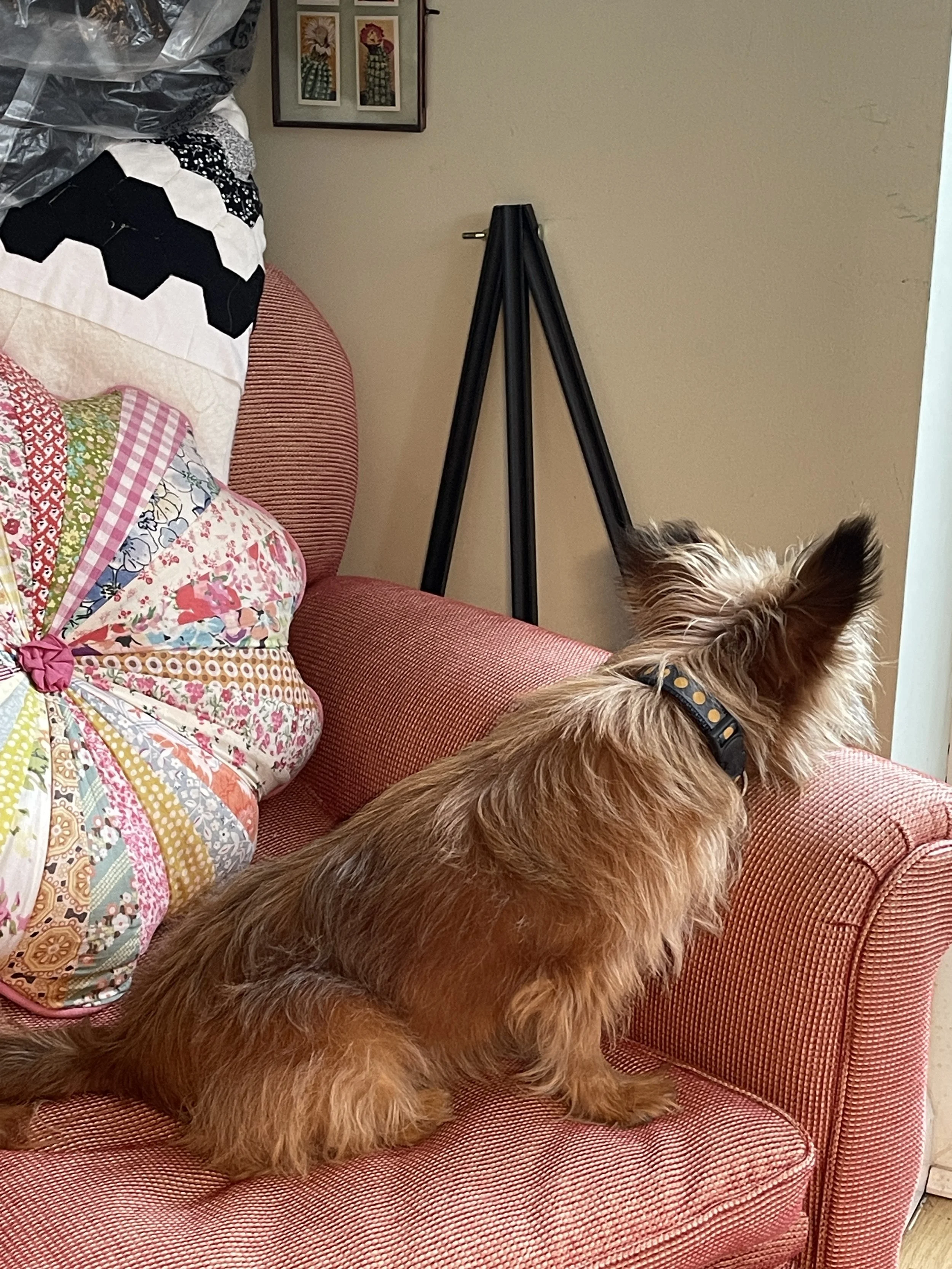
Mojo has found his favourite spot in the office. Photograph: Jane Perrone
It’s time to introduce my new rescue dog and show mascot Mojo. Plus I answer a question about wick watering techniques and select three planty podcasts you need to hear.
Want to hear this podcast ad-free? Sign up for my Patreon now to unlock ad-free episodes, bonus episodes and much more!
The planty podcasts I pick out are:
CREDITS
This week's show featured Whistle by BenJamin Banger (@benjaminbanger on Insta; website benjaminbanger.com).