Episode 317: Anthurium Breeding Insights and more with Dr. Jeff Block
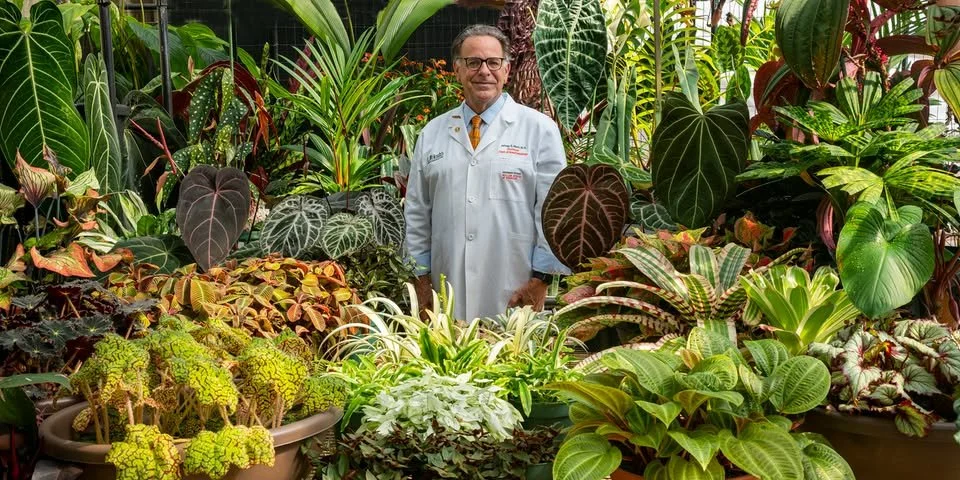
Dr Jeff Block with some of his plants at home in Miami, Florida
Transcript
Doc Block (00:00) A time frame of what could be as long as four or five years from the concept to the pollination to the seeds to the germination and selection has now been pushed down and I can do it inside of two years. So the benefit of that is not simply the person who wants to get an anthurium nowadays because it's prettier as far as the new leaf. They're easier to grow, they're faster to grow.
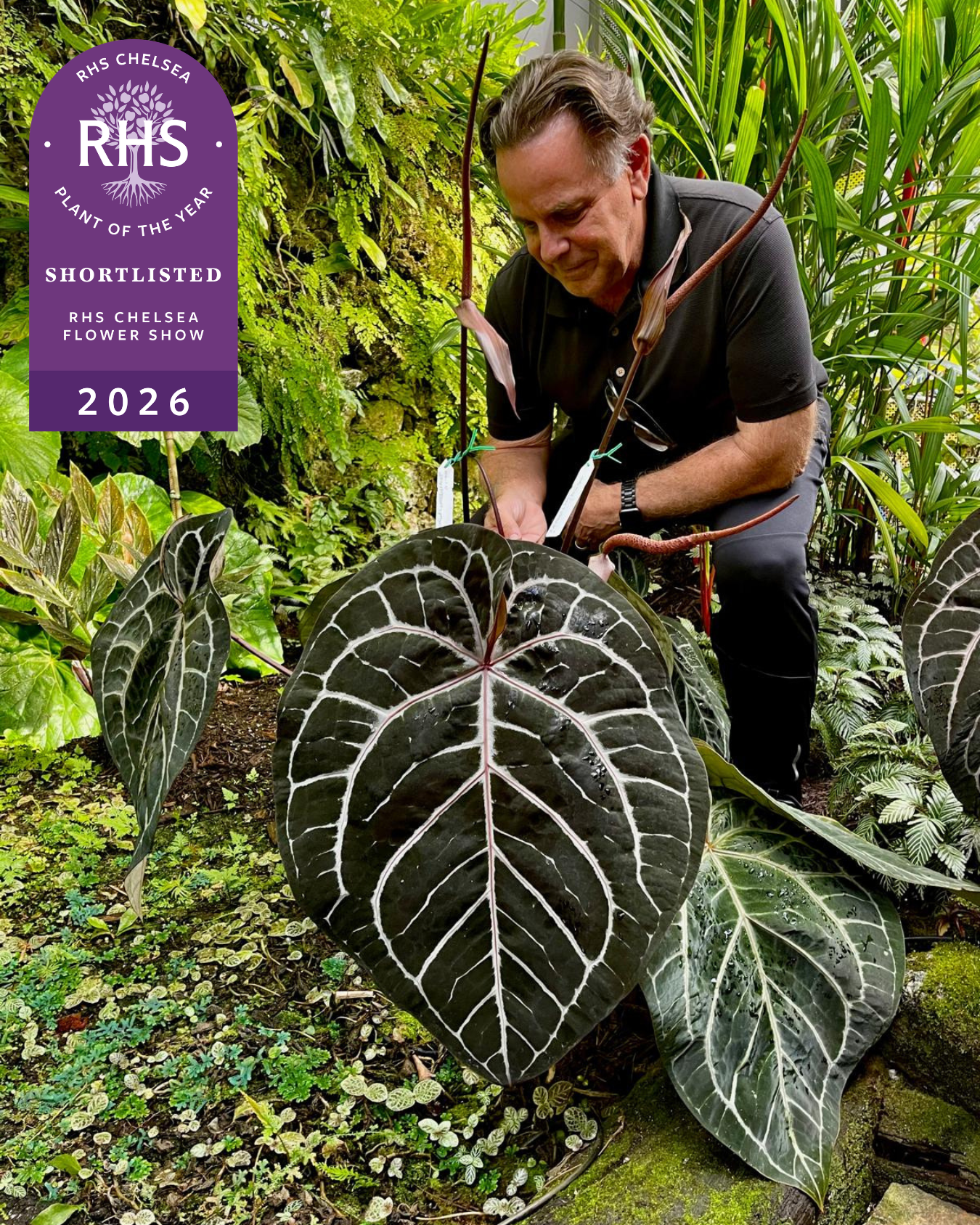
Jane Perrone (00:31) Hello and welcome to On The Ledge Podcast. I'm your host, Jane Perrone. And in this week's show, I'm chatting to a legend in the world of anthuriums. Dr. Jeff Block, AKA Doc Block, breeder of many a beautiful tropical plant and the creator of Anthurium Michelle, a plant that made it through to the finals of the prestigious
RHS Chelsea Plant of the Year. I'll be finding out why the right water matters when it comes to velvet anthurium. Why the slow pokes get the heave ho if you want to produce the perfect anthurium. And why naming a plant after your wife has hidden benefits. If you've not come across the good doctor before,
He really is a doctor. He's an anaestheologist based in Miami, Florida in the U S who has spent decades growing tropical plants, establishing a botanic garden in his own garden and producing some wonderful new cultivars of plants we love. But he's best known, I would say for his Anthuriums. Just to give you a bit of context about this interview,
Dr. Jeff Block was in London for the Chelsea Flower Show where his Anthurium, 'Michelle', was up for an award. The RHS Chelsea Plant of the Year award, which is open to all kinds of plants, not just house plants or tropical plants. In fact, tropical plants haven't traditionally featured very much in this competition. Sad to say, 'Michelle' didn't win.
that went to a hosta, a red tinged hosta called 'Red Ninja But even so, it was great to see an anthurium up there against lots of other very worthy plants, including a streptocarpus, one of my favourite plants from Dibley's nursery in North Wales. They were also finalists in this competition with their streptocarpus.
'Sirius' and I'll include details of that plant in the show notes along with an image. And talking of show notes, do check out the show notes at janeperrone.com as you listen or check out the YouTube channel for some images of the plants we're talking about in this interview and more information about Doc Block.
The official supplier of Anthurium 'Michelle' in the UK is the house plant seller Grow Tropicals. And they hosted an evening with the doc after the press day of the Chelsea Flower Show. And I was able to take some time for an interview about all things Anthurium and so much more.
So tell me about Anthurian 'Michelle'.
Doc Block (03:48) Anthurium 'Michelle' is, well, for the first part, named after my wife Michelle, because she makes her far more tolerant of the hours I may want to spend in the greenhouse than I'm not indoors with her or playing with the
Jane Perrone (04:02) Michelle,
you confirm, is that true? He would get up in the middle of the night to look at the plants to be sure they're okay.
Doc Block (04:09) if it's that cold outside, yes. But anyway, it it's the time, the attention and things. So believe me, it didn't hurt that it was named after her. Absolutely. It's not the first plant that I've developed. I can't say I bred are you familiar, you you know orchids? So another dark it's not purpley, it's brown purple. Ludisia orchids, jewel orchids. Yes. Well, jewel orchids are some things that ⁓ again, this is more than ten years ago, I'm certain.
I had entered in certain shows. I've entered plants in shows for decades. I mean 40 plus years, starting with bromeliads, some orchids, certainly other aroids before. And so this is what's called a CCE, a certificate of cultural excellence. It doesn't mean it's my hybrid.
But when you get that through the American Orchid Society, they allow you to give it a clonal name. And the clonal name of that is Michelle's jewel. Mm-hmm. So it's happened before, cheaper than real jewelry.
So the idea is I've I've hybridized for years. Why wouldn't I want the first plant named after her? The other names are of likewise of people who I enjoy first if it's a special name. There's other ones that might describe the plant itself I mentioned before dark and Handsome' This is kind of dark and handsome.
Jane Perrone (05:32) What you pick that out as what were the characteristics that really made you go, I'm onto something here among those hundreds of seedlings that you produce off a pollination episode?
Doc Block (05:44) Well
remember I mentioned before about some people liking wide veins? Some of the first wide vein plants that I was selecting for were a relatively round shaped leaf with wide vein distribution and the background might be brown or even sort of gray black and it resembled a tortoise shell. So that's why that name is 'Tortoiseshell'. It's not always the name of a person. It it's just sometimes the name fits the plant. There's a new interest in very dark.
mean, ⁓ the guy over there's wearing black. I'm wearing black here. So we have to how many names can you come up for black? even with the white veins, we tried seeing if we could s could secure a name ebony and ivory, but couldn't. It was already the song. 'Michelle' was tough enough 'cause of the Beatles song. Okay. yeah, yeah. And that it's not that that
So there have to be qualifiers. My my partner in this who's there to protect our interest as far as a breeder. He's based in the Netherlands and is very familiar with this. So part of it was if I'm going to spend the time, energy, and money initially to develop this and share it, how do I protect it? Much less enforce it if it needs it. And I said that's not something I'm trained to do. So I've partnered with the right people who have
Been able to allow me to do what I like to do, which is continue breeding. And the strange part for me is that the name Doc Block, me, I'm the brand now, which is kind of strange for me because Doc Block has nothing to do with plants. The name Doc Block was a name given to me because after anesthesiology, my fellowship training is in pain management, which involves regional blocks, epidurals for women were getting very popular.
for childbirth and a whole variety of other blocks done with basically a needle skillfully being placed someplace to help alleviate pain and suffering. So so so the reality is my partners who knew that my training was specific to having skills in that set, they said, if you need need to have that treated, go see Doc Block. Right. So it's one of the benefits of having a a family name that's a a verb, a noun, and even a pronoun. So
Jane Perrone (07:42) had one. ⁓
Right.
Doc Block (08:03) So a you know, a proper noun. So these are all sort of ways of things evolving that brought medicine, healthcare, names. when people want to know about tips for growing, especially those people who want to get into breeding, they maybe got their first little plant, 'Michelle' or otherwise, growing it out. No, now they have their first flower.
And they are so eager to to try to breed with it that they will take a plant that has a relatively immature root system, it could only be a few years old, maybe one or two little flowers on a young plant. And I always cut those flowers away because until the plant is of a large enough size, it may not have the root system to absorb what's being challenged, which is asking it to maintain itself during the stress of reproduction. All plants
Reproduction is stressful. Making fruit is stressful for a plant. This is essentially making little berries, which are the fruit takes energy.
Jane Perrone (09:08) Does it like you know a lot of aroids ⁓ heat up their spadix to when they're when they're doing the pollination?
Doc Block (09:16) It
will pull on in the Anthuriums there is usually an associated leaf with the flower. So that particular leaf, if it's showing wear and tear, it's that mommy leaf putting all its energy into the flower to make babies. I will happily keep it on the plant even if it's starting to look tattered. Right. But for the same reason, but from a young plant, I d I tell people don't - don't challenge that young plant.
By trying to pollinate its first flower or two.
Jane Perrone (09:47) So the mature plants are your wonderful stock that you can then breed really good specimens from?
Doc Block (09:53) sure. Yeah, that that's those are breeding plants and they're not necessarily show plants.
Jane Perrone (10:00)
I'm always, somebody who's been born in the 70s, I'm always looking decade to decade at how some things in the world of indoor gardening, the house plant world, have really changed. And some things are exactly the same. So I'd love to know what you, the changes you've seen over the years you've been growing. I guess the biggest one must be this huge, amazing surge in fascination for aroids.
You must have been sort of caught up in this because this is what you do. You've been going along doing this and I presume enjoying it and having a great time breeding all these plants. But then suddenly the spotlight swivels and suddenly everyone's fascinated by these plants. How do you see it from your perspective?
Doc Block (10:54) It wasn't that I had always done this. I've always played with plants. It's just that a few plant families interested me more than others. And it's because I could probably affect the change in them. It wasn't going to be in palms, it wasn't going to be in succulents, it wasn't even in bromeliads, which was my first plant group. Because the time needed to do generational changes with breeding or
the sizes of seeds or or the other things that make it technically more challenging. I just would let the plants just show me what they wanted to do rather than to try to steer them. But I was always fascinated with the big jungly looks of leaves. And it wasn't limited to anthuriums, many aroids, alocacias in particular, philodendrons, monsteras, these big size leaves were sort of kind of something that's, you know, outer outer space type size and
⁓ of interest though is that being in Miami, I don't have any houseplants. Yeah, of course. They're all outside. No, I have a lot of windows, but no house plants inside.
Jane Perrone (11:51) course.
Does that affect their growth? Do you find that you are able to achieve bigger foliage, chunkier leaves because you've got maximum light, you know, you've got that ultimate light situation that everyone in indoor gardening is sort of jealous of, I suppose.
Doc Block (12:14) ⁓ time. It it's time more than the elements and that's because at least in the US the average homeownership time is only seven years. ⁓ really? So if you're developing something in a landscape, again, not so much indoor plants, then seven years somebody else comes in and they have a different idea and very often it's plowed down and start again. So if you look for botanical gardens around the world for models of how to sustain those plants to see what they really can grow into.
That's why our property, now that we've been there 36 years, is considered a member garden of the American Public Gardens Association called Block Botanical Gardens. It's not, you know, 100 acres like some of the other big places. I don't have tram rides and bookstores and volunteers. You're looking at it. But nonetheless, we we qualify for that. And that's what's opened up doors around the world, including Q where I'll be at this coming Thursday. And
other gardens throughout the world, because that's where you get to see those things that are grown larger that gets fascination. But getting to where you're asking about the anthuriums in particular.
The anthurium leaf, just like the others, a big regale, for instance, is the name of one, which is a huge leaf, silvery veins on a green background, but of the jungle size that's just sort of fascinating, makes me feel like a Liliputian in proportions. That fascinated me, but when I started with these, what were called velvet leaf anthuriums, it's because unlike the Anthura type with the flower anthuriums that you see many more of.
The velvet leaf ones, if grown with good quality water, and that's key, have a velvety sheen to the way the little cells on the surface of the leaves reflect. That's why they're called velvety. They may not feel as much velvety, but they sh they look that way. And that sort of fascinated me because again, with clean water, and we'll get to the water. those plants looked unique. Now
Some had silver veins, some were just plain green leaves, but everything was green. And I got some plants years ago that had a hint of pink or a hint of lavender in some of the newer leaves coming out, which is where that's most firmly expressed, and then the leaf chlorophyll evolves. But pink became a redder pink and then a red and then a fire engine red while the lavender worked its way into a deep violet purple. So Michelle's the purple
one, and I've got others that do the red line. But if if you look at the visual spectrum, you'll see they're at opposite ends, red, yellow, green, blue, violet. And then in the middle is that green. So when they start one way and then they eventually all turn green, they go through an intermediate stage, which can be very colorful. But then those colors are no longer green velvet. It's red velvet. It's purple, violet velvet. And purple velvet's regal.
So that's why I mean you've got a king here. Look at look at look at the purple velvet you'll see in special occasions. That's why that particular kind of aroid, Anthuriums, fascinated me, because I could breed something that wasn't there before, regal purple velvet.
Jane Perrone (15:29) So you have an idea, you want to bring out a particular Anthurium characteristic and make it better or produce something particular. What's your time scale there? Are you thinking, in 10 years time, this is going to be ready or are you able to?
Doc Block (15:45) Every single hybrid cross is a roll of the dice. You just want to stack the dice. So what's done then is you start off with something where you know that in a given flower, you may have a hundred up to a thousand seeds from one flower. And I don't want to grow a thousand plants from every single cross I do. So in what's called a community pot or a community tray, these individual seeds will germinate.
And in pretty short order, start to show their potential for two things. One is whatever the visual thing the breeder's looking for is, whether it's a color, the shape of the leaf, things like that. But the other thing is the vigor, because life's too short to wait for all the slow pokes, the 999th out of a thousand seeds to come up. So you throw a lot of things away, but you're also selectively breeding them for vigor, for growth. And so
A time frame of what could be as long as four or five years from the concept to the pollination to the seeds to the germination and selection has now been pushed down and I could do it inside of two years. So the benefit of that is not simply the person who wants to get an anthurium nowadays because it's prettier as far as the new leaf. They're easier to grow, they're faster to grow, including from seeds. So you have a lot of people who are actually interested in breeding them.
Jane Perrone (17:10) I just did an
episode on this. on my podcast, we have an annual sowalong where I encourage people to grow houseplants from seed. And so this is a particular fascination to me because I feel like I've been struggling uphill for a long time to try to say, try pollinating your plants, try growing stuff from seed, try growing ferns from spores. It's so much fun. So can you give me like a 30 second sell?
Why should people be growing houseplants from seed? What's so great about it? Because I feel like I've said enough about this subject on my show, but why do you love growing from seed?
Doc Block (17:42) Well, I look at it to try to put together two plants that I really curious with each plant being so beautiful. And remember, these flowers have a male and a female stage to them. When I put together such beautiful parents, how ugly could the kids be? So so by doing it in the way that's done then, I think that people if they're gonna look back at what is there now compared to forty years ago, it's that there's better color expression from far more than green.
And they're faster and easier to grow. And if you stay with a breeding program for decades, then you can contribute that to whoever wants to follow or create something on their own. Because I'm not done breeding. I'm still doing it, you know, on a regular basis.
Jane Perrone (18:28) What's
the unicorn plant that you've yet to create?
Doc Block (18:31) ⁓
there is no one unicorn. People ask me my favorite plant. That's usually what I'll say about a single malt scotch whiskey, whatever's in my cup at that moment, because you learn to appreciate it rather than say it's my favorite. Same thing with kids. If I ever said which one of my kids is my favorite. So I don't go there. You're not gonna goad me into, you know, giving you that answer so cleanly. I have a few things I'm working on that I'm always amazed at
not what necessarily I find beautiful, but what other people do. And there's a huge fan base and now through social media and following, you get to see trends. And the trends are different in different places in the world. We've just come back from spending a month, the whole month of April between Japan and China, where the aesthetics over there are notably different than they are here, but they eventually evolve and get around the world. People I think are interested in the plants here because they really haven't seen
Velvet leafed anthuriums in the UK before. And that's because of their popularity and now being introduced as houseplants. Nobody's going to a garden center and seeing it in the winter display outdoors. So brought inside, it's pretty comfortable where you and I are. And that's roughly numbers of 60 to 80 are the numbers I like people to think of, because whether it's degrees Fahrenheit or percent humidity.
If you can keep things in that range where you're comfortable, generally the plant can do pretty well.
Jane Perrone (19:59) Those are the two key things as well as light. What I wonder with Anthuriums is whether there's scope to make them even easier. Have you got more breeding goals where you're thinking, okay, I've made this really vigorous plant that is better in average room conditions than some of the more refined, you know, the species Anthuriums, but could you, think you can take that even further and make an even sort of tougher plant down the line? You're gonna keep trying?
Doc Block (20:27) I
I have one line of breeding through something that is a parent plant called 'Dark and Handsome' And it is, it's a dark leaf, but the actual turgor of that leaf is very thick. You know, it even when the leaf is young and develops, it's not as easy to rip like many of the anthurium leaves are when they're still very young. so so turgor may be one element that I'm working for that you wouldn't think is important. It makes durable. Experimenting with different light intensity.
You don't not you don't want to sunburn the plants, but at the same time, if it's grown in too little light, the stem, otherwise called the petiole, will tend to get elongated and the leaf even larger because it's searching for the light that's not as available. so because the growing point of the velvet leafed Anthuriums is something that presents in a rosette shape from a single plant, I'd rather be able to, if it's a commercial plant also, grow something under
bright but filtered light so that it gets to be a little more compact than you might see some people be able to push them in size. It's not the size, it's the overall proportions and how it fits as a houseplant and what size containers.
Jane Perrone (21:36) Yeah. And let's go back to water because you said that was important to you. I use rainwater on all my houseplants because I come from an area where the whole water is very hard, lots of mineral deposits in there. How do ⁓ you get the best water for your anthuriums where you are?
Doc Block (21:54) My my background with appreciating water actually goes back to the mid to late nineteen eighties. And that's when I had my very first job as a physician. And it wasn't passing gas for a living as an anesthesiologist. It was actually working on cruise ships in the South Pacific. So I was the ship surgeon as a merchant marine back there. But on cruise ships, I was able to visit French Polynesia, the Society Islands, and the Hawaiian Islands, two different ships.
Same route every week, but I could get off the ship in any port and then explore those islands. And what was different there is they had rainwater coming all year round. There wasn't what we have in Miami, which is a wet season, five months, and a dry season of seven more months. So I realized way back that the plants suffered during the dry season, especially at the end of it. They really needed to be, you know, better hydrated, but nature wasn't bringing it.
And I'm uniquely situated. I have all the fresh water you could ever imagine because I sit in the well, it's called the Florida Everglades ecosystem, meaning that it's a the Everglades is actually a very slow moving, shallow river. It's not a swamp. And that source of fresh water means even where I live, I could drill down 20 feet and bring up potable water. Now it's potable, but it's full of limestone, which is the coral rock that's our bed there.
And so it leaves a lot of calcium, calcium carbonate is the chemical - chalk. That's what calcium carbonate is. So if you irrigate only with dark groundwater, you will see that chalk deposit develop over everything you irrigate it with. And it looks kind of crusty and salty. And you know that that has to interfere with the leaf's ability to photosynthesize where the light has to get through. Imagine going through wax paper on every single leaf you have.
you wouldn't be getting right through to the chloroplast, those cells that need it. That's the way plants derive their energy from sunlight. As a matter of fact, it might surprise you, but most of my plants get no extra ⁓ feeding. They get the right balance of light, air movement, certainly water and temperature. And that's the way God intended it. Not with not with the, you know, fertilizers. ⁓ it doesn't mean I can't use things at different times to boost plants, and I do.
But for the most part, those four elements of everything that I've just mentioned between the light temperature, the
Certainly the water there and the
Jane Perrone (24:33) Humidity?
Doc Block (24:34) Airflow, sure. Thank you. Yeah. The most important is the reason we're exploring the cosmos today, looking for water. Okay, water, water, water.
Jane Perrone (24:42) does that so presumably that that purity of water that what you're saying is that that helps those velvet and theorems to produce the most velvety leaves?
Doc Block (24:53) Well, you can see the velvet because the chemical deposits from the salts are not being left on it. Imagine it in terms of a parallel. Again, I like to give parallels with human health care, but imagine what what atherosclerosis does to your insides of your vessels lining because it's constantly laying down these plaques that eventually compromise blood flow. I I sort of view it that way of constantly putting things down on the
energy engine that the leaf's surfaces filled with chloroplast. Those are the cells that permit a plant to photosynthesize, which is a really cool trick. It tells the plant how you can use light to make it into your energy. Yeah. We can't do that. Paint us green, it doesn't happen. Plants do that magic. And even the chemical, the molecule that is chlorophyll is remarkably similar to the molecule in us that's hemoglobin.
The thing that carries our blood, and I can show you a slide later. that's interesting. ⁓ is one that was my aha moment. When I was in college, ⁓ taking, you know, regular college courses, I was a chemistry major and they showed us a molecule of chlorophyll. And I thought, well, that's nice. And in the middle of chlorophyll, there's a cation it's called two plus is cation called magnesium.
A physician uses iron the same way that a farmer uses magnesium. You're not going to give too much, but without it, the central core way that chlorophyll does what it has to do couldn't work. Iron in hemoglobin, and hemoglobin looks remarkably like chlorophyll. A physician would use it the same way a farmer does, especially in a woman, say when she's pregnant. And you know there's an anemia associated with pregnancy.
Any any physician is going to optimize iron by giving a little extra, it doesn't hurt, but you need to optimize both. So in essence, a physician is using hemoloba for people from essentially the same molecule as a farmer would with chlorophyll to ensure life and optimal performance. Those are the two key energy molecules in plants and animals, and we're not that biochemically different.
Jane Perrone (27:14) So when you started getting into plants, must have been like, ⁓ this is interesting. Plants and people not so different.
Doc Block (27:21) Well, I wasn't really starting to get I was already into plants. But I started medical school and in medical school I got to see what a molecule of hemoglobin actually looks like. That was the aha moment. To say, I've seen this before and in fact I had. So
Jane Perrone (27:36) And do you find that the plants, the messing around with plants, if I can degrade it by making it sound very basic, but your time spent with plants, presumably what must be a very stressful job working in medicine, was that your of your de-stressing time or was it just a different kind of challenge or what do you get from plants that complements, that complemented your career in medicine?
Doc Block (28:00) Well, maybe my career in medicine is not that typical because of being an anesthesiologist. I like to think I enjoy talking to people like you right now, but there's sometimes I don't necessarily like to talk to my patient. Good night, Mrs. Smith. And they'll wake they'll wake up a few hours later, provided that I've given her the right assurances before. And then wow, you know, it it's over. Well, plants don't really talk back with you.
Raising, we talked about raising teenagers before too. So I do it as my little place to escape to a certain extent, but it it's interacting with things that as they develop, I'm not just l telling ⁓ applying a recipe to what I do with plants. I'm actually trying to figure out what the plant's telling me it wants me to do for it.
So that if you are truly a good observer and you realize that plants are existentially rooted, they can't flee from a natural threat, whether it's an herbivore, weather, insects, things like that, then the plants have to be ingenious in the way that they engage their surroundings, which is basically through our five senses. Yeah. Or if we're gonna get into plants' ability to get into the brain, the sixth sense.
But it's exactly what you're speaking about because it's trying to bring light to the way that plants engage us and whether it's smell, taste, feel, you know, certainly hearing's an interesting one too.
Jane Perrone (29:32)
I want to just go a bit more into his plant observation. I think I once said that plant care is like 90 % observation, 10 % perspiration. But I think going deeper than that, you can go and look at a room of plants, you could look at, for example, this Monstera that's right here and somebody else could look at it and they could see very different things or they could not see or feel.
or even hear some different things. So when you're looking at plants, how are you engaging your senses to see what's going on?
Doc Block (30:17) I'm looking for what most people don't look at. It's what you can't see. It's the roots. That monstera, if you look at it closely, has a few aerial roots. The leaves may look good, but if you look at the way the aerial root that's going towards the ground suddenly becomes pencil thin, that's a sign of trauma. That is not a healthy root. It's put out a branching one to the side. But I look at things kind of quickly to to make an assessment and I realize that what I need to see the most is things that are hidden from me because it's underground
And so, you know, most of those things you can take some chunks of this, but from a leaf itself, other than if you're a lab, you're not going to get a whole plant to grow out. You cut the top of the plant off and you very likely will get offshoots coming out because of a healthy root system. Not a healthy root system, you've just killed your plant by taking the top off.
Jane Perrone (31:06) People spend a lot of time worrying about one damaged leaf, but they've never looked at the root.
Doc Block (31:10) Roots.
no, that's that's that's it's that's your backup. ⁓ you know, w one damaged leaf is a moment in time, but a healthy plant is gonna be represented by how healthy the roots are. very simple.
Jane Perrone (31:21) That is a very wise piece of advice. I'm just aware of the time and you've got to give a talk soon, but I just wanted to ask about where you're going next. You were talking in the car on the way here about your next projects. In terms of plant breeding, are there things that you're still like, am I going to be able to achieve this in my lifetime? Is this going to be possible? Are there things that you would just love to do that maybe are
too hard? Like, is there a plant that you just can't see ever being able to create?
Doc Block (31:55) Yeah. No, no. A a lot of it is there. I have different concerns as a breeder than I would if I was just a collector or having a very narrow range for something I'm looking for. ⁓ I'll give an example in the slides that I show on something from nearly four hundred years ago, the Dutch tulip craze, which was a very dark leaf tulip with variegated, you know, patterns in it. And ⁓
Only recently has that variegation been found to have come from a mosaic virus. Yeah. And so if you're a breeder, you really don't want to introduce viruses. We talked before even about cannabis. And in a cannabis grow, tobacco mosaic virus will make you have to throw away an entire crop. So there would be no smoking in a cannabis grow of a tobacco cigarette. I because I've I'm
Jane Perrone (32:26) Indeed.
Doc Block (32:49) More comfortable and I'm not pushing for the next strange variegated anthurium. I don't tend to concentrate on variegated plants, which are very popular nowadays. I do like certain vein patterns. The range of colors, shapes, sizes of leaves, and even to a certain extent,
the speed at which they grow in which environment. I've done crosses say with regale. That regale is more tropical. And so because it's more tropical, it's cold intolerant even in Miami in the winter. I we've had some cold. It gets just below freezing, where it will die to the ground and no recovery. So I've done a cross which keeps not quite as big of a leaf, but a similar looking leaf where
the cross I did with a crystallinum is more cold tolerant. Doesn't mean it's very cold tolerant, but it's more cold tolerant. Because future years I grew two side by side. No more regale, but more of the other one. So these kinds of ways that I look for things, I wanted to get more of a portfolio of different looks and shapes, colors, sizes. Other things that I would still be doing might be to take.
Good traits in even a species. There's a species called carlablackiae - carlablackiae has a unique flower and the vein pattern is is still kind of unique, but it's not a very easy plant to grow compared to most of the other ones. So I've done a cross with something that you would think is like it, but it's really not genetically. It just has a similar vein pattern. And that vein pattern has a lot of long veins, but with very little lateral branching. And so, ⁓
If you're understanding visually what I'm describing there, that is a look that a lot of people are very fond of ⁓ with those kind of vein patterns. The people in China now are very hot on very wide silvery expression of the veins rather than no veins or st or very thin ones. ⁓ but part of it is keeping up with trends of what's popular in one part of the world or another. Yeah. Other ones might be things that just
get to my imagination. And then finally, as I said, only a month ago I turned 70. So I'm not looking for a 20 year project to do. I'm looking for things to keep me active stimulated, whether one plant family or another, just to sort of leave a mark on what plants can bring and whether it's happiness or therapeutics or some mysterious combination of the two by working with them.
Plants are engaging us much more than people realize. And that's where the power of plants to engage us is fascinated me and still does. So I'm not sure what's going to come up next that's ready to be released. I'm not a fool business wise. I'm not releasing things the moment that I have them. I'm actually holding on to things for two full generations before I would release it. And that's because I know there'll be people who would like to copy.
And otherwise, you know, claim that is theirs. ⁓ when I release something that I already have two years forth, and I have somebody show me something that is quite beautiful, then I'm gonna go ask them, how did you do that? Because I don't want it to be a one-way street. I know there's people around the world that are doing some beautiful things with them. It's just getting the interest up. And even those people, if they're doing anything that still has colors in the leaves other than green.
I'll take that as enough of a compliment that they liked what they saw that would have had to have come from me. Or that they're doing it at a rate and proficiency because of how easy they are to grow now that wasn't so many years ago. That's an attribution in a sense.
Jane Perrone (36:44) I think
you're about to be on stage very shortly, so I should stop recording. All right. This good. I really enjoyed it. And I'm sure my audience is going to be fascinated to hear from you. And I know I've had a lot of people say, ⁓ wow, you're interviewing him. So I'm really, really privileged to have you on show. Thank you so much.
Doc Block (36:48) Yeah.
You're welcome, Jane. It's pleasure meeting you.
Jane Perrone (37:12) Thankyou so much to Dr. Block for chatting with me and also to Grow Tropicals for allowing me to interview the good doctor while they were setting up for their event, which was great fun too. I'll be back next week and I'm going to be talking to Lindsay Sisti, AKA @alltheplantbabies about how to save your houseplants through propagation. A really vital episode, so.
Do tune in, check out my YouTube channel, there'll be a full video version of that episode, plus an extra for Patreon subscribers, all about alocasias. I'll see you soon. Bye.
Hello, World!
Explore the fascinating world of tropical plant breeding through the expert lens of Dr. Jeff Block, an anaesthesiologist and passionate anthurium breeder. Find out why slow pokes get the heave-ho in the breeding process, why naming a plant after your wife has hidden benefits, and why water quality matters when it comes to velvet Anthuriums.
Want to hear this podcast ad-free? Sign up for my Patreon now to unlock ad-free episodes, bonus episodes and much more!
This week’s guest
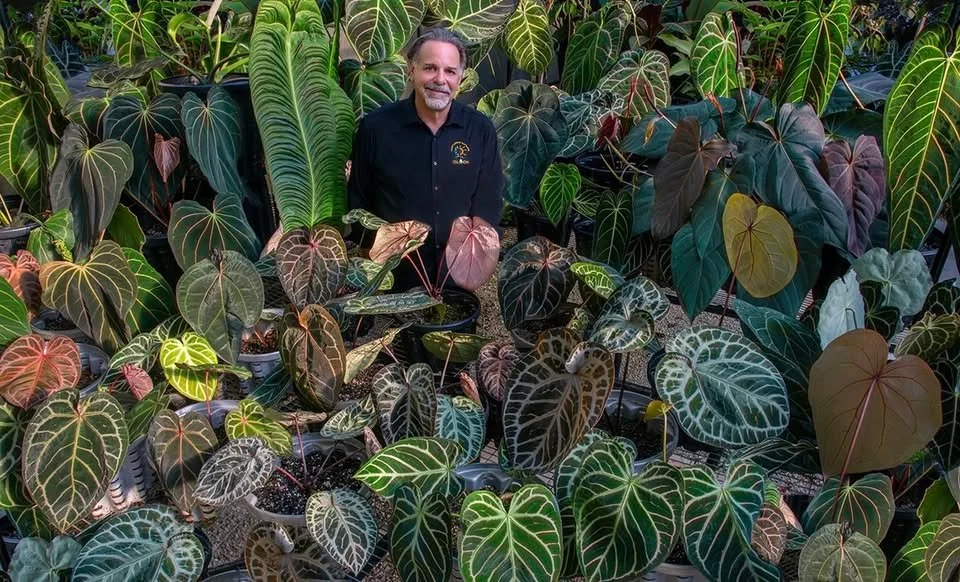
Dr Jeff Block is a Miami-based physician-botanist best known for breeding tropical plants including Anthuriums.
You can find him on Instagram as @therealdocblock and do check out his YouTube channel.
Doc Block Anthuriums are available for sale in North America here and ‘Michelle’ is available from Grow Tropicals in the UK.
Find out more about Anthurium 'Michelle' on RHS Chelsea Plant of the Year.
Read more about Anthurium ‘Dark and Handsome’.
See more of Doc Block’s Anthurium creations in this video.
Chapters
00:00 - Accelerated breeding timelines for anthuriums
00:31 - Introduction to Dr. Jeff Block and his tropical plant journey
03:48 - The story behind Anthurium 'Michelle'
05:32 - Naming plants after loved ones and protecting breeder interests
07:10 - How to choose parent plants for breeding success
09:16 - The significance of water quality for velvety leaves
10:54 - Changes in indoor gardening trends over decades
13:23 - The allure of large, jungle-style anthurium leaves
14:14 - Breeding for bold colors like purple velvet and red hues
15:45 - Breeding timelines and selecting for vigor
17:42 - Growing houseplants from seed: Why it’s rewarding
18:32 - The challenge and joy of creating unique plant cultivars
20:27 - Breeding goals for more resilient, easier-to-grow anthuriums
21:36 - The importance of water and environmental conditions
24:42 - The science of chlorophyll and plant energy molecules
27:14 - How plant care parallels human health and observation skills
30:17 - Engaging senses to assess plant health
31:10 - The importance of roots over leaves in plant health
33:10 - Future breeding ambitions and exciting trends
35:32 - The philosophical approach to plant breeding and legacy
36:44 - Wrapping up with insights into the vibrant world of tropical plant cultivationResources &
CREDITS
This week's show featured Whistle by BenJamin Banger (@benjaminbanger on Insta; website benjaminbanger.com) and The Road We Used to Travel When We Were Kids by Komiku.