Episode 307: Pickle plants
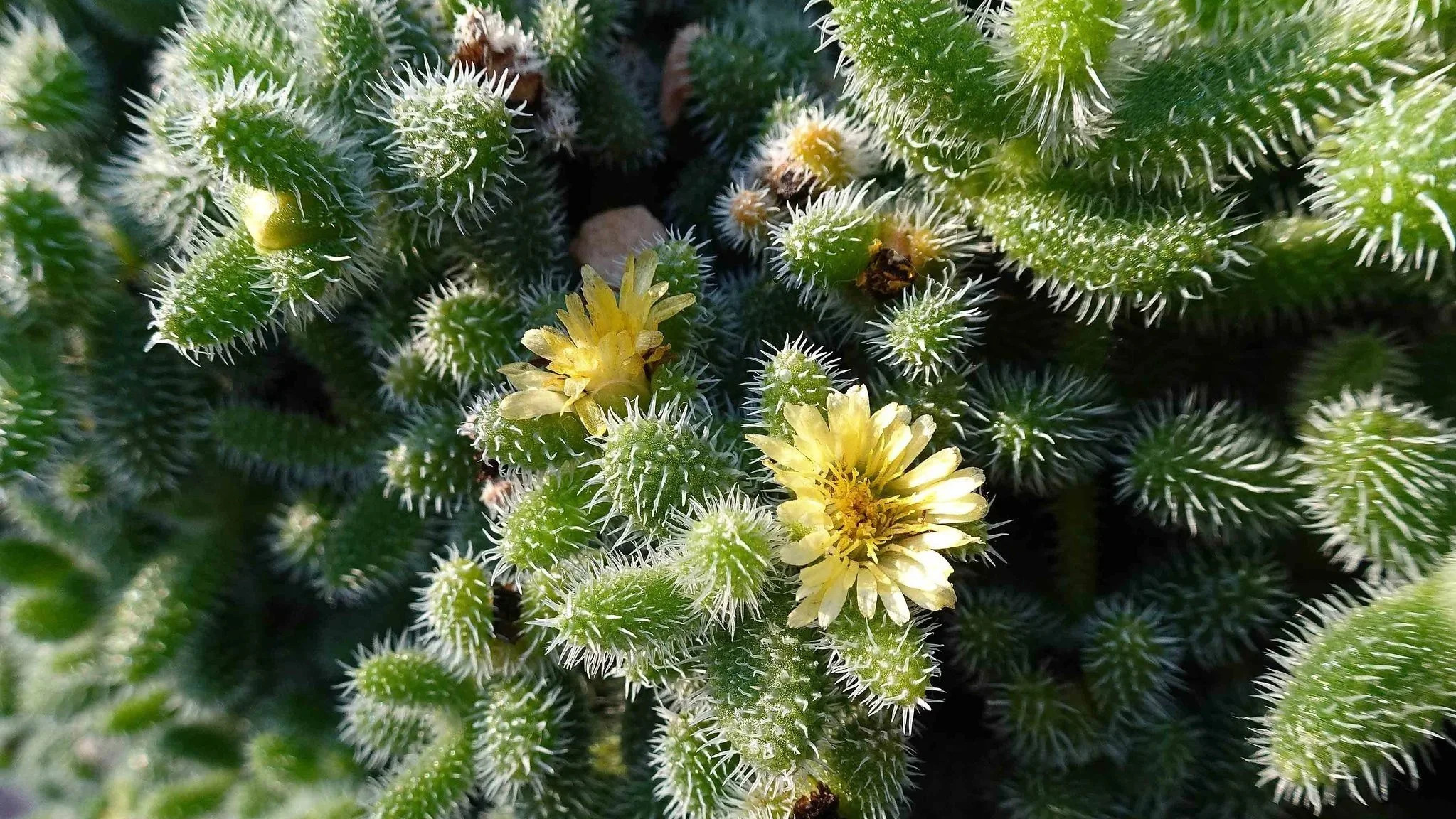
The pickle plant has daisy-like flowers. Photograph: 阿橋花譜 HQ Flower Guide on Flickr
Subscribe to On The Ledge via Spotify, Apple Podcasts, Player FM, Podchaser and YouTube.
Transcript
[0:33]Welcome Back to On The Ledge
[0:27]In today's show, two plants that are pickly and delicious. Don't eat them, though. Please don't eat them. But we're talking about two succulents, both known as the pickle plant, that are definitely worth a look if you're thinking of adding to your sunny plant collection. And I'll be letting you in on the return of On the Ledge, what it all means, and updating you on my own planty journey. So where to start? Well, last week I got made redundant from my job. So what started out as a normal working day rapidly turned into me crying on a Slack call.
[1:17]But you know me, I'm resilient. I'm a resilient woman. And I went out for a walk and I wrote some notes. I've got a new notebook, a new redundancy notebook, which is starting to fill up with ideas. And of course, the first idea was bringing back this here podcast because I've really, really missed it. So much has changed in the past nine, yes, nine years since I started on the ledge in 2017. But the one thing that hasn't changed is I absolutely adore plants, in particular indoor plants. My collection has fluctuated. My amount of time that I have to spend dealing with plants has fluctuated too. But yeah, I still just adore houseplants and love talking about them. So that's what we're going to do. That's what we're going to do, folks. So I would love your support.
[2:19]If this is your first episode or your 300th and something episode of listening to on the ledge thank you for being here first of all that's support right there so thank you very much.
[2:31]And if you are feeling sorry for me, which I hope that you don't, I hope that you just want to support an independent creator. I'm just going to list a few ways that you can support me if you feel so able to do so. You could just tell somebody about On The Ledge. I was walking my Cinnamon Trust dog the other day. So I walk a dog for the charity, the Cinnamon Trust for its elderly owner. And I passed a guy who has this really beautiful houseplant collection in the window of his house. He was in the front garden and I just stopped and started talking to him about his plants and complimenting his collection.
[3:08]I just happened to slip in that I have a houseplant podcast. And within a few seconds, he's got his phone out and he's found me online. So these little connections can be amazing. So if you've got a planty friend that perhaps hasn't listened to On the Ledge, I'd love you to pass on that information to them. You can also buy my books. Legends of the Leaf is now self-published and available widely The links will be in the show notes The Atlas of Deadly Plants is widely available too You can listen to them as audiobooks and listen to my two other audiobooks about allotments The Allotment Keeper's Handbook and The Wild Garden by William Robinson So perhaps pop over to your Spotify or your Audible or your audiobook app of choice or borrow them from your library, your audio book library or your print library.
[4:02]That's a great way of supporting me. And just to say, if any of you want a hardback copy of Legends of the Leaf, I do not have many left. I have, she looks at bookshelf, probably less than six copies available and there won't be any more. There just won't be any more of these. That's it. That's all the supply gone. Those of you who know about the Unbound saga will remember that I've now self-published the book so.
[4:33]It's a new edition. It's paperback, the original hardback. There aren't going to be any more of them. It's got a beautiful foil cover. I will sign it for you. So if you want one of those, contact me directly. You can buy from eBay if you prefer. If you look up Legends of the Leaf signed by author, you'll find it there. You can also join my Patreon, which is back up and running this month, and I'm going to make sure it is livelier than ever. I want to know what Patreon supporters want from me. I've just put up a post about Swedish Ivy and Donald Trump.
[5:09]Imagine a mimed spitting sound right now. Yeah, go and read that post. It's free. You can go and read that post, whoever you are. It's all about a plant that used to be a historic feature of the White House and has disappeared. Um so yeah plus there's going to be loads more coming up on patreon and you can join me as a free member or one of my three tiers of membership i'd love to see you there, you can also leave a review for on the ledge uh rate and subscribe that would be most welcome and follow me on instagram i'm on tiktok as well because i'm just down with the kids like that Right, that's enough of bigging myself up. Let's get on with talking about what's coming up on On The Ledge. As yet, I'm not quite sure because all this is very, very new.
[6:16]The Pickle Plant Love
[6:10]This new news that I have to pivot and pick up where I left off with On The Ledge. So if you've got some episode ideas, if you'd like to be interviewed, I'd love to hear from you. What would you like to hear on On The Ledge?
[6:31]Fascinating Perrone Jr. fact. When I was about 13, I guess, I was so in love with pickled onions that I bought a jar, a huge jar of pickled onions with my own pocket money and kept it in my room because my mum had told me that I was eating too many pickled onions. So I took matters into my own hands, of course, and bought a jar for my own personal use. God knows how offensive my breath was, but there we go. But I still love pickles of all kinds. Top tip here, unrelated to the podcast, is if you haven't ever tried pickled celery.
[7:20]Really do try it even if you don't like celery because pickled celery is amazing it's so good! But I wanted to talk about two plants that are called the pickle plant, In honour of both my love of pickles and also in honour of my work daughter, Bryony, from the job I've just been made redundant from. One of the great joys of the job I've just been made redundant from was my wonderful colleagues, including Bryony, who is a wonderful individual. And we share a love of pickles. so yes our Instagram exchanges usually consist of pickle related reels we just love all things pickly I just introduced her to apologies for the terrible Italian pronunciation lampascione which are pickled muscari bulbs a very particular species of muscari that Italians I think it's in Puglia they preserve these bulbs like pickled onions and they're a particular taste and I introduced Bryony to those and she very kindly bought me one of the two pickle plants we're talking about for my birthday earlier this year so it seemed an appropriate moment to chat pickle plants.
[8:45]And I'm going to be looking at two different species in this episode, both known as the pickle plant, both succulents and both from South Africa. I wonder in the case of both of these plants, whether pickle plant is a fairly recently applied moniker, because I looked back in various succulent books trying to see when they were first called this name. And they don't seem to have been called pickle plant for very long. I have a suspicion that people think oh well let's call it pickle plant and it will sell better to the pickle addicts and they're probably right as well. But these plants have lots of other names too some of which I'm not gonna lie are a little bit odd such as hedgehog sheepfig which to me sounds like the name of - I don't know maybe a peasant in one of those fantasy paperbacks that you know come in about 20 massively thick volumes - 'here comes Hedgehog Sheepfig the publican selling a yard of ale'.
[10:01]I don't know. That's just the way my imagination works. Anyway, we'll come back to the names in a bit. Let's start with plant one. And this is where scientific Latin comes in useful because, this is the only way we can tell exactly which plant we're talking about here by using that double name to identify the plant. And the one we're talking about is Delosperma echinatum.
[10:28]Delosperma - you might recognize that genus name because this group of plant contains quite a few popular plants Delosperma the ice plants they're widely known as are they're actually sold as bedding plants here in the uk that's the species Delosperma cooperi which are great for really really sunny spots because they come from hot places they do well in the summer in the uk not winter hardy, however. And Delosperma is a member of the Mesemb family, the Aizoaceae. Flippin' heck, some of these names. The Mesembs, let's call them that. So they have these daisy looking flower heads in bright colours or sometimes in white and they spread across the ground, their ground hugging ground cover plants now echinatum that means prickly and indeed this plant is prickly to look at but the good thing is it's not going to do you any harm those prickles are soft and tactile in fact i have seen this plant marketed by a company i'm not sure which one with a label that says, hug me, I'm soft.
[11:47]So, yeah, I wouldn't necessarily recommend hugging these plants. They're a little bit fragile, but you can certainly run your finger across those soft prickles without any danger of harm. Talking about harm, this plant is declared a... Safe for pets so it is probably a good choice if you have nibblers in your midst. If you've read my book Legends of the Leaf you'll know that I love digging up cultural and sociological stuff about plants and this is no exception.
[12:21]I did discover that Delosperma is according to the South African National Biodiversity Institute important in KwaZulu-Natal where it is one of a group of plants called intelezi - I don't know if I'm pronouncing that right that are considered good luck plants botanically speaking there's a few interesting things about these particular plants and the first of those is its hydrochastic seed chambers - gosh we're getting back into the fantasy novel land again - what is a hydrochastic seed chamber? Well it's basically a evolutionary adaptation that means that the seeds are only released when there is rainfall in other words when they're going to germinate so the seed capsule opens up as soon as it's hit by rain to release the seeds and then once the rain goes away the seed capsule closes back up this is not the only plant that does this if you've read Legends of the Leaf - plug plug plug - you'll also know this is something that the stone plants the lithops do it's a really fascinating adaptation that is definitely worth a mention what are the flowers like on this species they are yellow they're daisy like uh they're okay you can see them in the show notes at the very top of the page they're not bad but i prefer the prickly leaves and the reason why those leaves look as they do almost sparkling in the sunshine is because they're covered in vesicles.
[14:00]What is it with the botanical jargon, Jane? I know you're asking, but we need to know about vesicles. So these are basically lumpy bits all over the plant that store water. That's the non-technical explanation for a vesicle. And basically it's a water holding cell that helps the plant to keep water when there's not much of it around. That's why they look so prickly, but actually they are soft. And in china it's known as spiny leaf dewdrop in translation which fits the bill pretty well like the other members of this genus it's a low growing sort of like semi shrubby, spreading plant so it might get to 30 40 centimetres tall but it's gonna spread more horizontally than vertically and in terms of your care for this plant let's get on to the key points here a lot of people buy this plant just like they buy the string of pearls from a general house plant shop and it dies quite quickly i would predict i and this is completely off the top of the old dome i don't have any stats to back this up but my guess would be that at least half if not two-thirds of the pickle plants purchased - lord that's hard to say - are going to die within about a year and the reasons for this all come back to our old friend light so this plant may well be being sold to you as a plant that doesn't need a lot of light wrong wrong wrong it does need a lot of light it comes from south africa it's growing um close to the ground so there may be some kind of vegetative cover that's blocking out some of the sun but light levels outside in South Africa are going to be still enormously higher than in your living room even if the plants have a little bit of vegetation cover so you really do need to find a super sunny spot for this plant in your home and you need to supplement with a grow light if you do not have that otherwise you're going to end up with a plant that's very leggy etiolated That means just stretching towards the light.
[16:19]It's also going to cause you problems with the roots because these plants are usually sold in a mix that's quite water retentive, which is fine in the nursery where they can provide those high light levels. But it's not going to work in your house so take it out of the pot knock off as much of the soil mix as possible and repot into cactus and succulent compost if you possibly can i've got mine in a terracotta pot which will also help those roots to stop getting saturated which leads to root rot which leads to plant death which none of us want let's be fair.
[17:04]So sunniest windowsill, loads of light and the usual rule for succulents. If you're in the UK or similar climes to me, that's going to mean a rest period November to March ish, where you're reducing the watering, ideally reducing the temperature and keeping the plant quite dry. And then during the growing season around now to October, you'll be increasing the watering and occasionally feeding too. Like the vast majority of succulents, its nutrient needs are low because it has evolved to cope in a low nutrient environment. So if you can get some cactus and succulent feed and use that every so often when the plant is actively growing, great, that will help it to grow. And it can grow quite fast. As I said, I think the name pickle plant is probably a marketer's idea in the last few years, but it's also got lots of other names, including the not very inspiring prickly leaves de la sperma and the aforementioned hedgehog sheepfig. I'm guessing because they're eaten by sheep?
[18:19]If you want to make more, you should be able to propagate from a stem cutting. I found them to be a little bit tricksy in this regard. The best advice I can give you is to nip off a piece of stem and then allow it to callus over to dry out for a couple of days before putting it in some gritty compost. And it should root. That said, as I say, sometimes it just dies off for no reason. It's not quite as generous as, say, something like the jade plant Crassula ovata in making new plants. I've read quite a lot on Facebook forums about people struggling, and I too have struggled with propagating this one. So if anyone's had great success, mine seems to be just random, but if anyone's had any great success and has some tips, please share them with the group.
[19:12]Exploring Pickle Plant Number Two
[19:07]Oh, and I should say, talking about propagation, that the Sowalong will be back in 2026. So get some houseplant seeds now because we're going to be talking so along in the not too distant future if you're new to the show that means our annual effort to grow houseplants from seed yes it is possible yes it's exciting yes you can join us uh so yeah check back on my website janeperrone.com just put in so along and you'll find out some information there about previous so-alongs if you can't wait to get started.
[19:55]And on with plant number two. This is the other pickle plant. Now, when you think about a pickle, I don't know what pickle you're thinking of, but certainly the Delosperma, the plant we've just talked about, to me looks like a tiny gherkin, or if we want to be fancy, a cornichon.
[20:19]Whereas this plant, number two, I don't know, I guess it more resembles one of those massive gherkins that you get in a big jar, or increasingly one of those, you know, trendy pickles that comes in a like a little zipped bag, plastic bag. Have you seen those? Do you know what I'm talking about? are kind of bizarre, but very popular. And I've enjoyed a few myself. But if this plant really was a large gherkin, it would be one that's been on the old Zempick because it's extremely thin. So each little stem is pencil sized, I guess we might say, a chunky pencil sized at best. They are quite fast growers and they have these ribbed structures which as i say give them a kind of a gherkin-y type look although the scientific latin name - Kleinia stapeliiformis - is telling us that the plant looks like a stapelia not a gherkin. I don't know what the latin for gherkin is answers on a postcard please but this plant has loads of names it's called pickle plant it's also called candle plant.
[21:36]I should point out that on the RHS website, they call it the Stapelioid Kleinia, which I guess is a more accurate name than the pickle plant, but a bit less marketable, I suppose. Now, I can't quite remember which website this was on, but I have seen this plant called the belisha beacon plant. Belisha beacon plant? Are you actually kidding me? I'm going to have to even Google what a Belisha Beacon is because I've kind of forgotten. Belisha Beacon.
[22:15]OK. So it's this is a British thing. So, again, it's probably worth me telling you. So it's a plant that has a flashing amber globe atop a black and white striped pole. It's a crossing pole, basically, that you get in various parts of the world, including the UK. And I guess that's because of the flowers. So you get this... Pickle-like stem and then at the top the orangey red inflorescence pokes out the top and I guess that's the bit that looks like the orange flashing light on the top of a Belisha beacon. Wow I mean I'm not going to be calling that plant that name anytime soon but it's absolutely up to you. Common names are interchangeable. We're just going to call it the Kleinia pickle plant for now just for the sake of differentiating from the first plant we talked about so yeah it has a lot of things in common with the Delosperma also from South Africa also a plant that lives in a spreading fashion doesn't get very tall so it might get - what are we talking about here - 25, maximum 30 centimetres tall. In its native home it would not get hugely tall because of lack of water and high sunlight so if your plant does get terribly long and tall and floppy that means it's not doing well and it needs more light so not a giant plant it's growing in the underbush in South Africa. It's got a bit of a Dr Seuss feel actually thinking about it the way that flower is structured uh if you have a look on the show notes at janeperrone.com you'll see a picture. It's described in the Timber Press Guide to Succulent Plants of the World as a 'striped dead stick with a bright pom-pom inflorescence' which I guess is another way of saying a belisha beacon plant. This plant used to be a member of the Senecios but it was moved to Kleinia because Seneciois one of those mega genera that is just absolutely huge and so uh plants are being removed from it because it's just so enormous. So it's often still described as a Senecio, but the current name for it is Kleinia. There are about 50 odd species in this genus of Kleinia.
[24:46]I will link in the show notes to a nice paper by the wonderful Colin Walker from the British Cactus and Succulent Journal, which talks about various species in the genus including our Stapeliiformis friend and Colin notes that they make good plants for bonsai style presentation so if you fancy a bonsai succulent this is a good one to go for.
[25:17]In that article, I also had my head turned by another species of Kleinia, Kleinia obesa, which is from Yemen and it has a thickened stem, which its describer, the French explorer and botanist Albert de Flaire, likened to a sausage apparently, but Colin thinks it looks more like a cucumber. Anyway I really like the look of this plant it's very weird I don't think it's probably widely commercially available but yeah one to look out for - Kleinia obesa - do have a look at that article it's really full of interesting pictures and descriptions of other plants in the Kleinia genus and in terms of the care instructions for this one very similar to the Delosperma a South African succulent. So we're thinking high light. We're thinking good drainage. If you don't do that, you're going to end up with super thin stems that are going to topple over.
[26:22]Spindly is the word that you might want to use to describe the look you'll end up with. Do not believe the bright indirect light brigade trying to sell you plants because they're lying about this one. Well, perhaps they're not lying. Perhaps they just don't know any better but yes it's a highlight plant so if your plant's toppling over or going all squishy yeah that's what it's caused by is the lack of light.
[26:51]So I've been talking about stems, and you may have realised that like a lot of succulents, this plant has evolved to ditch the leaves. Well, almost ditch the leaves, because if you look along the stem, you'll see there are these little structures, a bit like a little scale that are the vestiges of leaves where the plants evolved to make them smaller and smaller. So the stem is doing the photosynthesis and those scale-like leaf structures remain more or less as a bit of a decoration. And just like the Delosperma, if you do buy this and the potting mix that it's in looks heavy, does not look suitably well-drained, then do repot. And now is a good time to get repotting with some free-draining potting mix suitable for cacti and succulents. You'll note when you take this plant out of the pot that it has these very thick rhizomes under the ground and that's how it's spreading by just snaking underground and making new plants a bit like sansevieria as we should be calling them now dracaena trifasciata and the other members of the what was once known as the sansevierias and if you want to break off a bit of that rhizome that's a good way to propagate this plant pot it up separately and hey presto you've got a new plant.
[28:26]Personal Houseplant Journey
[28:24]So that's the two pickle plants maybe there are other plants called Pickle plants: fill me in if you can think of one but I'd love to know also which pickle is for you - yes I want you to pick a pickle! Do visit the show notes for links and pictures and so so so much more if you want to join my patreon then I'll be doing an extra leaf episode where i'll be talking about where I'm at with my personal houseplant collection just to give you a little taster of that I'll be talking about my Thai constellation which I first bought in 2018 as a tiny plant what's happening with it now. I'll also be talking about 'Marie Kondoing' my collection and learning the art of letting go and I'll also be talking about a very interesting paper by the succulent legend that was Gordon Rowley about unspecialization and why growing a range of different plants rather than obsessively collecting one particular kind of plant might be the way forward.
[29:42]Closing Thoughts and Farewell
[29:43]Well, that's it for this episode of On The Ledge. Thank you for welcoming me back. And I will be back next week with another episode. Not sure what it will be about yet, but we'll figure it out, guys. We'll figure it out. And I would just love it. [30:45]
Two plants named after the pickle, both from South Africa, both succulents - and one episode of On The Ledge dedicated to them!
In this episode I explain why I am restarting On The Ledge, what you can do to help, and why I love these two pickly plants.
OTL housekeeping
Want to buy a copy of my books Legends of the Leaf and The Atlas of Deadly Plants? All the details are here. Don’t delay if you’d like a copy of Legends of the Leaf, the hardback edition - I only have a very few copies left and there won’t be any more, ever!
Want to know more about UK charity The Cinnamon Trust? Details here.
Want more? Join my Patreon! You can join for free or choose one of my paid tiers. There’s a fre-to-access article about Trump and the missing White House plant to read right now!
Want to get ahead on the OTL Sowalong? Check out these episodes.
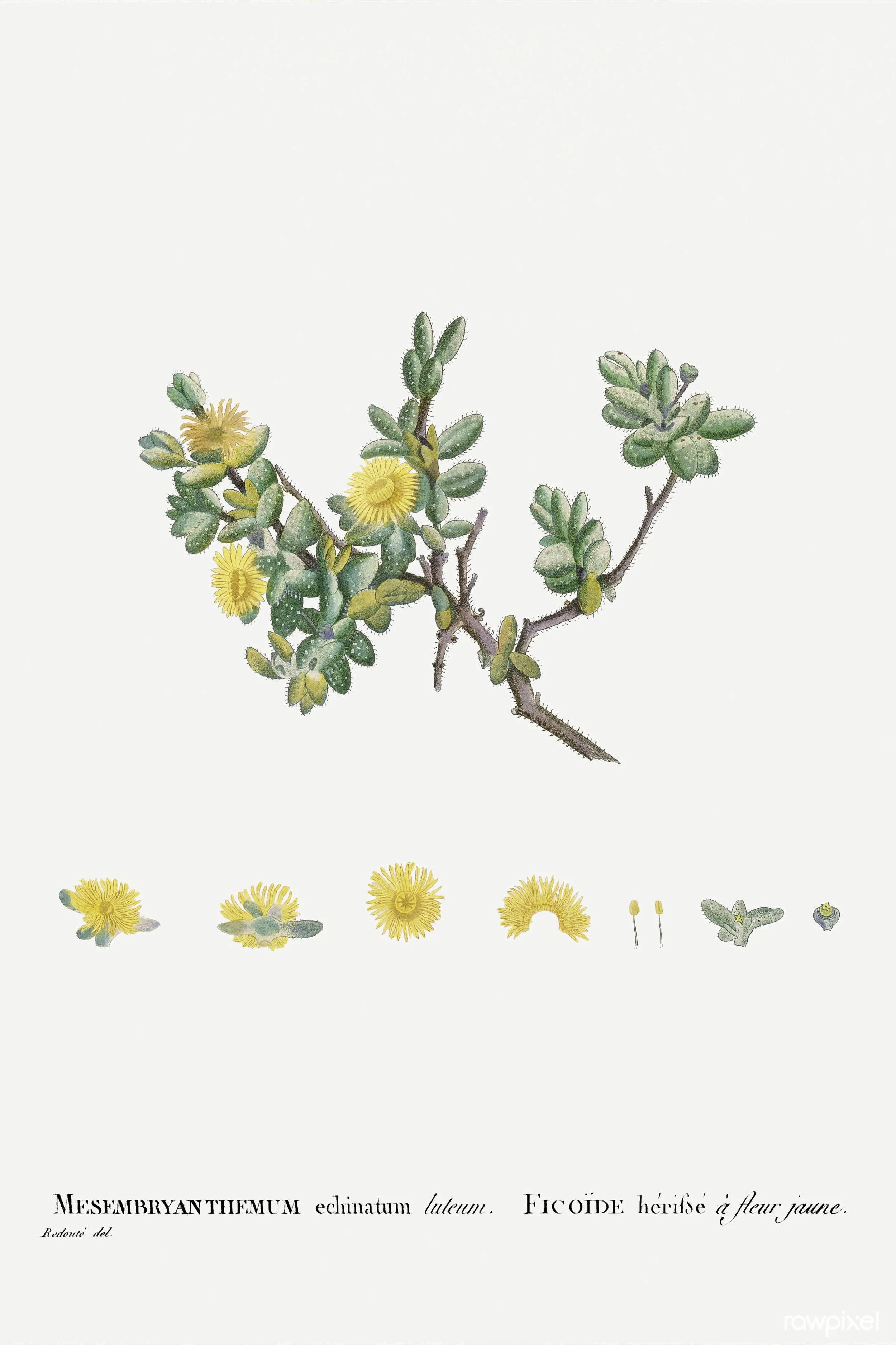
Delospema echinatum pictured in a botanical illustration from from Histoire des Plantes Grasses (1799) by Pierre-Joseph Redouté. Original from Biodiversity Heritage Library. Digitally enhanced by rawpixel.
Pickle plant no. 1 - Delosperma echinatum
This plant comes from South Africa and is a low-growing, spreading subshrub succulent that can reach 30cm or so.
It has many names including hedgehog sheepfig, prickly-leaved Delosperma and it’s called spiny leaf dewdrop (in China).
The pickle plant has hydrochastic seed capsules which open to spread seed only when it rains.
The plant looks prickly but the prickles are soft! The leaves are covered in vesicles which are water-holding cells that help the plant store water and give the plant a sparkling look in sunlight.
In terms of care as a houseplant, give it maximum light and use a growlight if you don’t have sunny windows.
It also needs free-draining potting mix so repot if yours comes in claggy, water-retaining substrate. Use cactus and succulent compost. Putting it in a porous terracotta pot will also help to stop the roots from rotting.
Allow the plant to rest during its dormant period - Nov to March in the Northern hemisphere.
Its nutrient needs are low but use some cactus and succulent feed occasionally in the growing season.
Waht to make more? Propagate by making stem cuttings - it can be hit and miss affair so you may have to have a few tries!
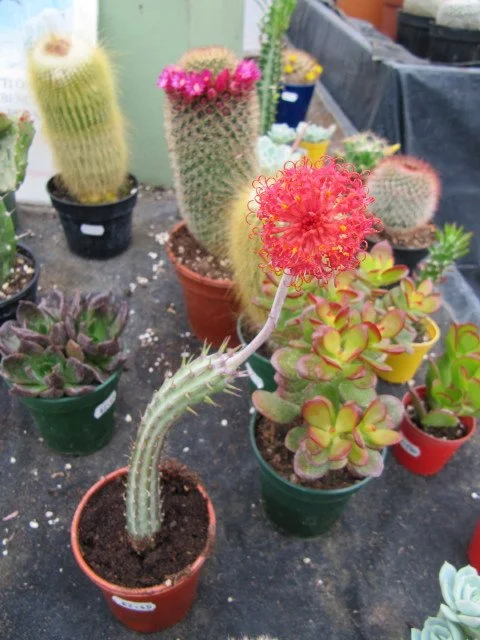
The Kleinia pickle plant in flower. Does this look like a belisha beacon to you? Photograph: Leonora (Ellie) Enking on Flickr
Pickle plant no. 2 - Kleinia stapeliiformis
This plant used to be a part of the Senecio genus but was moved to Kleinia. The genus Kleinia is an interesting one containing around 50 species. Check out this fascinating paper from friend of the show Dr Colin Walker to find out more, including the rather interesting K. obesa.
This plant is also known as the belisha beacon plant because of its flowers. It grows in the underbush of South Africa and is described in the Timber Press Guide to the Succulents of the World as ‘a striped dead stick with a bright pompom infloresence’.
It may look as if it has no leaves but it does have very tiny ones - these vestigial leaves look like little scales on the stem.
If you don’t give this plant lots of light it will become too spindly and will topple over.
It grows and spreads via underground rhizomes. You can cut some of these off to make new plants.
Care instructions are exactly as above for the Delosperma.
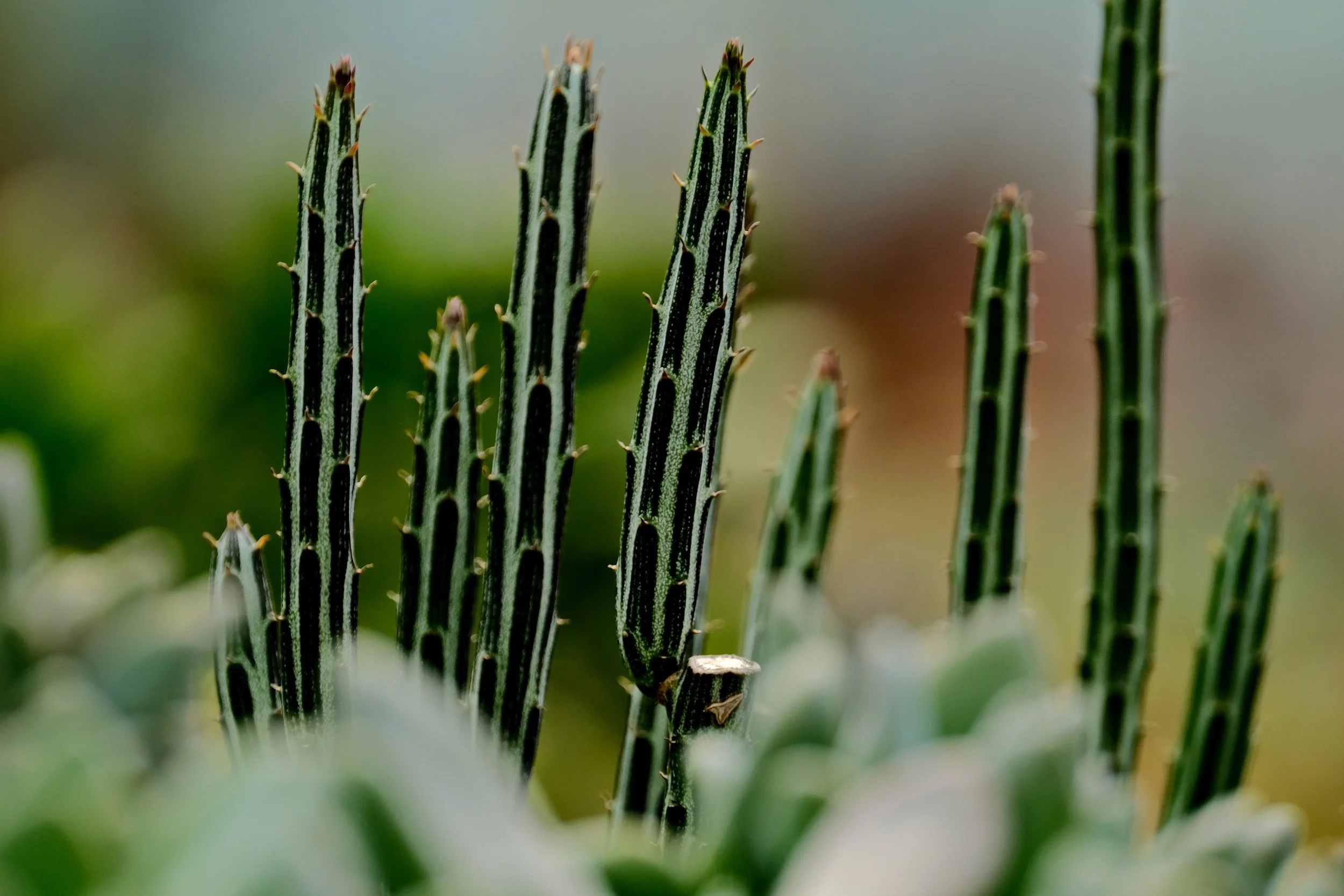
Photograph: ignartonosbg on Pixabay
CREDITS
This week's show featured Roll Jordan Roll by the Joy Drops and The Road We Used to Travel When We Were Kids by Komiku.