Winter Greeneries at Home - a Victorian houseplant reading
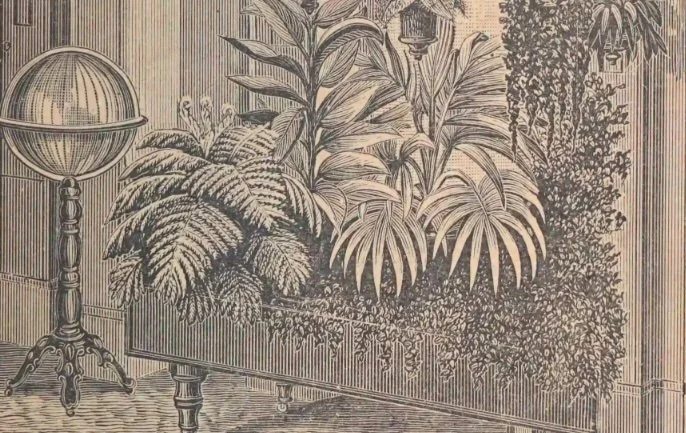
An illustration from Winter Greeneries by Edwin A Johnson.
Transcript
Transcript © Jane Perrone. Originally published at janeperrone.com. Please do not reproduce or republish without permission.
Jane Perrone: [0:01] This episode is sponsored by Sabz, the plant care app for your iPhone.
Jane Perrone: [0:07] Most plant apps tell you what your plant is. Sabz, that's S-A-B-Z, named after the Persian word for green, works out why it's struggling.
Jane Perrone: [0:20] A photo can't tell underwatering from overwatering, So SABS keeps a record of what you've actually done. When you watered where your plant sits, when you moved it. When a plant looks wrong, SABS weighs that history before the photo. And you can add records in your own words like it sits above a radiator and watch the answer change. Worried which plants are dangerous for your dog or cat? SABS has a toxicity reference for almost 300 plants. Cats and dogs judge separately, with almost all read straight off the ASPCA's own database. When there's no verdict, it says unknown, not safe, which matters at Christmas. The ASPCA has no entry at all for the European mistletoe we hang up here, and SABS won't pretend otherwise. There's no accounts, no ads, no tracking. Sabs is free to start, so check it out in the App Store today or visit the show notes at janeperrone.com for the link.
Jane Perrone: [1:36] Hello and welcome to On The Ledge podcast and it's time to head back nearly 150 years to find out how the Victorians were growing their houseplants in winter, and it might surprise you how similar it is to the modern day.
Jane Perrone: [1:56] I'm your host Jane Perrone and this is On The Ledge, the podcast for people who love greenery in their homes. This week I am bringing you an extract from a book that was published in 1878 and it's called Winter Greeneries at Home written by Edwin A. Johnson. Now he was an American, we don't know very much about him at all other than he really liked plants. And in this book, which has very much stood the test of time, he decides to answer a question from his niece Flora about how to look after plants. Whether this was an actual niece or just a conceit for starting a conversation about plants, I don't know. It does seem rather convenient that her name happens to be Flora, of all things. But he does.
Jane Perrone: [2:51] Include the letter from Flora, and she tells us that herself, along with Rose and Lily Richmond, Mary Minor, Jenny Weeks, and Daisy Burrett, all want to know the answer to how to keep plants alive inside. So I'm bringing you chapter three from this book, and if you want to read along while you listen. I will include a couple of links to have a look at the book itself and I'll include some pictures of the cover and some of the illustrations there in in the show notes at janeperrone.com. So this is designed to be a bit of a window back into the past as well as a relaxing listen while maybe you tend your own house plants this winter.
Jane Perrone: [3:41] A couple of technical points, some of the names that Johnson uses are a little bit out of date, but again, you can go and have a look at the actual scan of the book and work out what he's actually talking about. And when he's talking about degrees, as an American, he is of course talking about degrees Fahrenheit and not Centigrade. So that's useful background. The chapter that I'm bringing you is chapter three, which is called suitable plants, the differences, general hints and selections for situations. So settle back, get yourself a lovely hot drink of tea, coffee or your drink of choice.
Jane Perrone: [4:23] And have a listen to this lovely reflection on plants indoors in the winter. I hope you enjoy.
Jane Perrone: [4:59] The differences, general hints, selections for situations. You remember that the planting of the Old Eden was already finished when the gardeners took possession. It had been done by one who could make no mistakes, who put their only such plants as were sure to flourish under proper treatment.
Jane Perrone: [5:24] That certainly was of great advantage to the primitive florists as mere beginners. It left with them no such question as we have now to consider. It relieved them entirely of the necessity of selecting and experimenting under perplexing uncertainties. They could go to work at once with the assurance that their failures could come only from some mistake in the dressing and keeping, never from having the wrong plant in the wrong place. What a help such an assurance would be to us, it might not be best for us all things considered but it would certainly simplify the problem presented by the failures which have led you to ask from me these letters, in that case i might dispense with this letter altogether and proceed at once to the question of proper treatment, but remembering my own early failures as well as some later ones, I feel very sure that yours have arisen, in part at least, from an injudicious selection of your plants. Let us see.
Jane Perrone: [6:38] A few did tolerably well, you say, but many died outright or just lingered along like invalids. What a pitiful sight is this lingering and dying. How much it detracts from the pleasure of keeping plants in your rooms during the winter. Many persons give up the attempt altogether, rather than watch disconsolately the daily languishing of their pets. I am glad that you have had enough of success to save you from such utter discouragement.
Jane Perrone: [7:12] But why did not all your plants prosper alike? Whatever fault there may have been in the treatment, you gave them all alike, the best you then knew how to give, and yet the results were widely different. A few did tolerably well, neither died nor became invalids. If you had taken only those few at the beginning you would have had no failure at all and on making another trial you would doubtless regard them as suitable plants, as for the others the presumption is that they were the victims of unfavorable circumstances, you may take to yourselves the consoling reflection that probably with some of them at least no one could have done any better, that they could not have been made to flourish in your rooms by any possible art or skill. As the event seems to have proved, they were not exactly suitable. This difference of results in your first experiments with even a few plants points to some unexplained difference in the plants themselves by virtue of which some may be called suitable and others unsuitable.
Jane Perrone: [8:29] Looking now a little further, we come to the broad fact which lies at the very foundation of floriculture, namely the vast variety of nature and need among plants. As you know already, some live and others die in the same situation. Of course, there is a reason for this. Habits and wants belong only to things having some kind of life, and must be duly provided for in order to the support of that life. But in respect to their habits and wants, plants differ very greatly. Some grow as standards, others as climbers or creepers or droopers. All alike require light, heat and moisture, but in very different degrees. In their natural situations, all these differences are fully provided for. The places are as varied as the plants themselves.
Jane Perrone: [9:26] In every latitude or degree of heat, in forest shades or the broadest sunlight, in and underwater or at its margin, in rich deep alluvial soil, in the crevices of naked rocks or on dry and barren sands. Everywhere plants are found in natural conditions perfectly suited to their habits and demands. Now, these are the plants which for the most part are cultivated in greenhouses. Almost every desirable species has its representatives coming from all around the world. As their habits and wants are unchanged, you can see that their new and artificial conditions must be made to conform as nearly as possible to their original natural situations. If you were to visit any extensive collection, you would probably find many separate greenhouses with marked differences of light, heat and moisture. The one problem of the florist is to make the places suit the plants, and just as he is able to do this, he succeeds.
Jane Perrone: [10:36] But with us in our little greeneries, the problem is somewhat different, while the end in view is the same. That is, success in having only healthy and flourishing plants. We must take such rooms as we have, and of course cannot alter them to supply all the varied conditions required by widely different plants. Besides, our several rooms are likely to have very considerable differences in regard to exposure, temperature, etc.
Jane Perrone: [11:06] But whatever they may be, they are our only places for plants. Our problem is therefore a much narrower and simpler one than of the florist, namely the selection of plants to suit the place. That is to say, we must confine ourselves to a much smaller variety and take only those plants to which we can give something like their natural conditions. So, you see, it will not do to select any plants we may happen to fancy as we read about them in the catalogues of the florists or see them temptingly displayed on the market stands or in greenhouses. Many of them charm us by their wonderful beauty and seem exceedingly desirable, but alas, they are not for us, unless it be for a few short days or weeks at the most. We may take them only as visitors or temporary guests. In selecting our permanent companions for the winter, we need such as can feel at home with us and must decide, not by appearances, but by character and antecedents, taking into account their habits and wants or previous condition.
Jane Perrone: [12:23] But this, you will say, requires a knowledge of the natural history of plants. Very true, to some extent at least, unless you depend entirely upon other persons to judge for you. But you would prefer, I am sure, to judge for yourselves if possible. And the more of such knowledge you have, the better every way, not only in the selection, but in the care of your plants. The information you need may be obtained in part from the common descriptive catalogues of greenhouse and garden plants, but much may have to be sought for diligently in larger volumes and be rather difficult of attainment. But to you, will not this fact be stimulating rather than intimidating? With your spirit and enterprise, the unintelligent and merely mechanical cultivation of plants would be almost stupid. You might about as well have artificials and be done with it, but these living plants are continually appealing to your intelligence and challenging your skill while waiting to reward you with increasing beauty, they keep you constantly supplied with some interesting subject of inquiry.
Jane Perrone: [13:42] Something to be followed up and found out sooner or later. The pursuit of knowledge, someone has said, is better than knowledge itself. In this case, it gives you the habits and character of interested investigators, and its very difficulties enhance the profits. The genuine hunter finds the keenest zest of his pleasure in the chase, when it is literally a chase. But of course he brings down the game. So will you enjoy the very pursuit of information concerning your plants, and it may continue as long as you live. But the knowledge thus acquired will itself add greatly to your pleasure in caring for your plants. It will relieve you of needless anxiety and apprehensions, and give you a certain sense of power and confidence. It will be some satisfaction to know even their scientific or technical names and much more to feel assured of their proper accommodation in your rooms. And you will be delighted to find acquaintances beyond home through all the gardens and greenhouses around you.
Jane Perrone: [14:53] Wife and I have become so much interested in the history and habits of plants that we get no small part of our recreation in going regularly to the greenhouses in the city park. Only yesterday our visit there was rewarded by the sight of several exquisitely beautiful orchids, and we are now anticipating the splendid bloom of the poinsettia pulcherima, plants which we could never think of accommodating in our winter greenery. Without doubt Judge Kent and his gardener would be glad to give you all some such share in their greenhouse. People who love plants themselves are very likely to take delight in gratifying a similar love in others.
Jane Perrone: [15:40] But I must not forget that you have only just entered upon this interesting study of the habits and habitats of plants. Of course, I cannot accept your confession of being fearfully ignorant in floriculture and little better, in fact, than babes in the woods. For have you not already had the regular first lesson of experience? And yet for the present, you may properly claim the benefit of the experience of others, especially if they are not so far advanced beyond you as to be quite out of sight.
Jane Perrone: [16:49] 1. Reject all plants which have been forced into bloom for the market. This caution would be of more immediate practical importance to you if you are living here, where many of the florists cultivate plants for sale and bring them to the market stands in their most attractive stage. Such plants have been kept in hothouses in a condition much like that of mid-summer, and having thus reached the very acme of their growth, they must soon begin to fade. Ignorant of this fact, many persons purchase them, take them home to a lower temperature and then complain of their failures. Some of my friends who had thus become quite discouraged have now learned the better way of purchasing from cool greenhouses and waiting for the bloom.
Jane Perrone: [17:42] My own experience on this point I shall never forget, one of the first plants brought to my study years ago when I had a southern exposure was a bouvardia full of buds just ready to open, how tenderly I cared for it watched waited and wondered, but not a single flower but not a single floweret unfolded through all the winter. To use your words, it just lingered along like an invalid. With a little reading, I soon discovered the cause. In my ignorance, I had obtained the plant from a hothouse, where the forcing process was used to supply the cut flowers, which are sold for bouquets, wreaths, etc.
Jane Perrone: [18:30] I was not then aware that the bouvardia naturally requires a higher temperature than I allowed in my study. Of course, one lesson was enough, and I have since done all the forcing myself. 2. Take only young, vigorous and growing plants. If well-rooted before cold weather begins, they are more likely to endure the inevitable hardships of the season and situation, and you will have the pleasure of watching their growth if not their bloom. Youth and health, you know, always bear the charm of an unfulfilled promise, are full of happy anticipations, like yourselves. Besides, full-grown plants take up more room than you can well spare, or if cut back, they present a rather unsightly appearance. After flowering, they are generally used by florists for the growth of cuttings.
Jane Perrone: [19:28] 3. Give the preference to plants which take little or no rest during the winter, or have already passed their period of rest. Some greenhouse perennials grow more or less continuously, while others make a pause of weeks or months, as if waiting for better times. The latter, if very well treated, hold their own, and many of them are very desirable for their beauty of foliage. Nearly all may be expected to start into growth before the winter has passed, but here and there a plant seems to be very irregular and capricious. For instance, I have a fine pot of Smilax, Mercifilum asparagoides, which has had a lazy fit of more than 10 months, and I was just ready to throw it out when its asparagus-like shoots once more began to appear. Perhaps it would have done better in a different room, but it is hardly steady-going enough for me.
Jane Perrone: [20:28] 4. Make sure beforehand that your selections are not of deciduous plants, unless you like the sight of leafless stems. Near the beginning of my experiments, I barely escaped a mortifying failure, by observing this caution at the last moment. I was about to purchase for winter use several attractive but unfamiliar plants which were in full leaf, among them the crepe myrtle and Ampelopsis vichii, when I happened to ask if they were deciduous. You are probably aware that many trees, shrubs and vines drop their leaves in autumn from habit rather than frost. It is their way of resting or going into winter quarters. Of course, you will leave all such hibernating plants undisturbed outdoors or in the cellar.
Jane Perrone: [21:22] 5. Consider the texture of the leaves. As a general rule, you may safely take plants having leaves tough and leathery, like the Hedera, or hard and smooth like the palm, or the Ficus repains, or millismooth and lustrous like the Bergonia manicata. But unless you have a Wardian case, beware of the tender-leaved plants, and especially of such as are fuzzy like the primulus and some varieties of the begonia rex. The leaves are vital organs of the plant and cannot perform their functions well except when clean. All the first mentioned submit to sponging and drenching with evident delight, but many of the latter will hardly bear the touch of water while the hairs studding their surface catch and hold the dust of the daily sweeping. So, in selecting plants for the wear and tear of the everyday room, it is very necessary to find leaves which are warranted to wash.
Jane Perrone: [22:26] Six. Semi-tropical plants are generally to be preferred to the strictly tropical. Many of the latter, like the Cissus discolor and the tuberose, cannot be expected to flourish in the moderate day temperature which is most healthful for us, say of 65 or 70 degrees Fahrenheit. On the other hand, the more hardy plants of temperate regions are likely to suffer from the heat common in sitting rooms, and would do much better in any cool, airy place, free from frost. You need therefore to take observations determining the thermal latitude of your respective rooms and select accordingly.
Jane Perrone: [23:10] Seven. A few plants, like the Hedera, bear a great deal of neglect and ill usage and give admirable lessons in long-suffering and patience. Of course, they are all the more capable of responding appreciatively to the better treatment. Let me specially commend them to your favourable notice. Even such careful cultivators as you may sometimes find advantage in their excellent qualities, since accidents will happen. To say the least, it will be decidedly pleasant among your many very sensitive friends to have a few which will not feel hurt by a little neglect, and have sufficient stamina for roughing it on occasion.
Jane Perrone: [23:57] 8. Other things being equal, choose plants which are not specially noted for their hospitality to insects. You will find a great difference in this respect, though all plants are said to be given to hospitality and without grudging. Some seem to be continually overrun with guests, having become famous, I suppose, for an excellent larder, while others refuse nearly all applications for entertainment.
Jane Perrone: [24:28] As the food of the insects is generally the very life of the plant, and as you claim this for yourselves, you can avoid competition with them only by observing this caution. In any case, you are likely to have opportunity of studying entomology under the microscope. Nine. I suppose that, on the whole, you will prefer plants which will stand by you winter after winter, the slow-growing and long-continuing sort. Like old friends, well-tried and true, they have a value peculiar to themselves. An English ivy is now growing on my study table for the tenth winter. It is intimately associated with all these years of my happy home life and was part of the time all the greenery I had. What a blessing and delight it has been. but it has become so more and more with every added year until it seems now very much like one of the family i shall be glad to keep it as long as i live among the winters.
Jane Perrone: [25:32] 10. You will find it necessary to guard against the overstocking of your greeneries when so many very attractive plants are presented for your choice. Begin with a few concerning which you feel very secure and increase the number gradually as you come to a better knowledge of suitable plants. Half a dozen, well kept and thrifty, will give you more satisfaction than a score in the condition of invalids. Allow no plant to remain after you have become convinced that it will not thrive or cannot adapt to its place. Allow no plant to remain after you have become convinced that it will not thrive or cannot adapt itself to the place. 11. Please keep a record of your plants and in due time report all that do well or even tolerably well. You may thus contribute your share to the correction and enlargement of lists of plants suitable for culture at home in such winter greeneries as yours.
Jane Perrone: [26:39] After all these hints, perhaps you will be disappointed unless I furnish some lists for you. Well, as your experiments have had so recent a beginning, and as some of your friends may emulate your example and need help at the very beginning, I venture to suggest, chiefly from my own experience, but partly on the authority of others, a few selections for situations.
Jane Perrone: [27:05] As situations differ in respect to heat as well as light, I append to the name of each plant the degree or degrees of night temperature, generally regarded as the most suitable, with the understanding that about 15 or 20 degrees higher, according to amount of light, is the best for daytime. Practically, there may be some variation either way for both night and day, but you will find these degree numbers a very safe guide in making selections for rooms of a given temperature or for the higher and lower positions in the room, whatever may be the differences of situation as to light.
Jane Perrone: [27:46] 1. Shaded entirely from direct sunlight, whether in a north window or on the south side of east and west windows, a few kinds of plants will do tolerably well, if properly treated, such as.
Jane Perrone: [28:30] Acheranthes, 50 degrees. Agaves, century plant, 45 degrees. Begonia manicata, 50 degrees to 55 degrees. Euonymus, 40 degrees to 45 degrees. Callas, 45 degrees. Myrta's communis, true myrtle, 45 degrees to 50 degrees. Lily of the Valley, 45 degrees to 50 degrees All hardy bulbs, 40 degrees to 50 degrees 2. A partly shaded situation, having, say, two hours of either morning or evening sunshine, is much better than entire shade for any of the plants in the foregoing list, and will afford tolerable quarters for several more in the list next given.
Jane Perrone: [29:22] 3. In the forenoon sunshine, the whole or greater part of it, that of the afternoon being somewhat less suitable, any of the following will have a fair situation, if not the best.
Jane Perrone: [29:35] Ficus repanes, 50 degrees Ivies, 40 degrees to 50 degrees Madeira vine, 50 degrees, Agave, 45 degrees Murtis communis, 45 degrees to 50 degrees Begonia manicata, Begonia weltoniensis and Begonia hybrida multiflora, 55 degrees to 60 degrees, Callas, 45 degrees Hardy Bulbs, 40 degrees to 50 degrees. Fuchsias, 50 degrees. Lily of the Valley, 45 degrees to 50 degrees. Stevias, 45 degrees. Ardysia Crenulata, 45 to 50 degrees. Centorias, 45 degrees. Crassulas, 45 degrees Mahernia Odorata or Verticillata 55 degrees to 60 degrees, Linaria Cimbalaria Kenilworth Ivy 55 degrees, Latarnia Bourbonica 50 degrees to 55 degrees Ficus Elastica India Rubber Tree 50 degrees to 55 degrees Dracaenas 55 degrees to 60 degrees.
Jane Perrone: [30:53] Full sunshine in a southern or southeastern exposure with a temperature 5 or 10 degrees higher than in shade is doubtless the best place for nearly all winter flowering plants. Such as roses 50 degrees, carnations 50 degrees, geraniums 45 degrees, azaleas 45 degrees to 50 degrees, daphnes 45 degrees and many others. And also for the following cactus 50 degrees coleus 60 degrees hoia carnosa wax plant 50 degrees to 60 degrees, passiflora carulia passion flower 50 degrees or cuba japonica gold dust shrub 45 degrees palms and orange and lemon trees 45 degrees to 55 degrees.
Jane Perrone: [31:49] For the Wardian case, shaded from the rays of the sun, take ferns, nearly all the exotic varieties, 45 to 60 degrees, lycopodiums or salaginellas, 55 degrees, centradenias, 55 degrees, rex begonias, 55 degrees, pilea, artillery plant, 50 degrees, dracaenas, 55 degrees to 60 degrees, Gymnostachiums, 55 degrees Peperomias, 55 degrees Marantas, Crotons, Caladiums, etc. 60 degrees Such high temperature, you will understand, is more easily maintained at night in the closed case than in the open room.
Jane Perrone: [32:36] An entirely distinct collection, to be kept at a lower temperature, may be made of ferns, mosses, etc. Gathered from our own woods. This classification is doubtless more or less imperfect, and could not well be otherwise. But it will help you to avoid many of the most common mistakes of beginners. It embraces a sufficient number of plants for first selections at least. Nearly all are easily managed and have been mentioned particularly on that account. But you will probably need some further advice before you will be able to give them, in all respects, the proper treatment. Until you can do this and prove them otherwise, you may safely assume that they are suitable plants.
Jane Perrone: [33:49] Well, I do hope you enjoyed that chapter from Winter Greeneries at Home by Edwin A. Johnson, who apparently was also the author of books called The Live Boy and Half Hour Studies of Life. I'll have to search those ones out too. Do consider joining my Patreon if you are not already a member, if you are seeking extra on the ledge content, including my bonus episodes ad-free versions of the main podcast and...
Jane Perrone: [34:24] There's a chance to chat to me in the Patreon lounge where we can talk about anything from your planty problems to the planty books you're reading. You can become a free member to access that, but there are also paid tiers and the Legend tier, the most popular tier, is available for a seven-day free trial if you fancy trying it out at no risk to yourself. Check out patreon.com forward slash on the ledge to find out more. And on Patreon right now is my next edition of my bonus podcast, An Extra Leaf, which is a video podcast looking at my bog garden. Now I don't mean bog garden in the sense of a garden in a swamp. I mean the garden in my bog, which is the British slang for my bathroom, toilet if we want to put it that way and this is my office bathroom window ledge and it's a tiny space but I've got a range of forest cacti growing there which I talk to you about and go through my care regime for those plants and talk about why I love them and it's definitely worth a look if you want some more on the ledge content about houseplants and in particular if you love forest cacti.
Jane Perrone: [35:51] And the great thing is because I've been doing Patreon for so very long now, about eight years I think at Last Reckoning, there's so much more bonus content out there so you can dig deep into the archive. Absolutely perfect for a cold winter.
Jane Perrone: [36:24] On 10 years of On The Ledge. Have I helped you out? Have you had a question answered that has changed your plant's life or your life? I would love to hear your reflections.
This extract from a popular Victorian indoor gardening book show just how similar 19th century winter worries were to our own modern day preoccupations: will this plant survive the journey home? How cold can it get at night? And why do my plants look so miserable in winter?
The book I am reading from is chapter 3 of Winter Greeneries at Home by Edwin A Johnson, published 1878. You can see the text and read along here.
Want to hear this podcast ad-free? Sign up for my Patreon now to unlock ad-free episodes, bonus episodes and much more!
THIS WEEK’S SPONSOR - SABZ

This episode is sponsored by Sabz, a plant care app for iPhone made by Nasim Keshavarz, a sole trader in London. Where most apps identify a plant from a photo, Sabz tries to work out why yours is struggling. It keeps your plant’s history, then weighs that history first, your own observations second and the photo last, ranking the likely causes and saying when the evidence is too thin to know. Its toxicity reference covers 266 species, cats and dogs judged separately, almost all read off the ASPCA’s database, and says unknown rather than safe where no verdict exists. No accounts, ads or tracking. Free to start.

CREDITS
This week's show featured Whistle by BenJamin Banger (@benjaminbanger on Insta; website benjaminbanger.com) and Erik Satie: Gymnopedie No 3 by Kevin MacLeod. The ad music is Quasi Motion by Kevin Macleod.